





The ITIL career path is one of the clearest and most in-demand progression routes in Australian IT. It takes people from an entry-level Service Desk Analyst role through incident and problem management, service delivery, and eventually into an IT Service Manager position with a well-mapped ITIL certification at every stage. If you are asking “what comes after Service Desk Analyst” or “how do I become an IT Service Manager in Australia,” this guide lays out the full ITIL career path stage by stage, including the certifications, skills, timelines and salary bands you can expect along the way.
This guide is built for people already working in IT support in Sydney, Melbourne, Brisbane, Perth, Adelaide and Canberra who want a structured plan rather than guesswork. Each stage below links to the relevant ITIL certification so you can see exactly what to study next.
What Is the ITIL Career Path?
The ITIL career path is the typical sequence of IT service management (ITSM) roles a professional moves through as they gain experience and ITIL 4 certifications. It is not a single fixed ladder — some people move sideways into problem management, others move straight from team leadership into service delivery but the core route looks like this:
- Service Desk Analyst → Senior Service Desk Analyst / Team Leader
- Incident Manager or Problem Manager
- Service Delivery Manager
- IT Service Manager
- Senior IT Service Manager / Head of IT Service Management
Each step up the ITIL career path is supported by a specific ITIL 4 qualification, starting with ITIL 4 Foundation and building toward ITIL 4 Managing Professional and ITIL 4 Strategic Leader.
Stage 1: Service Desk Analyst Where the ITIL Career Path Begins
Almost every ITIL career path starts at the service desk. As a Service Desk Analyst, you are the first point of contact for IT users, logging and resolving incidents, handling service requests, and escalating problems that need specialist attention.
Core Responsibilities
- Logging, categorising and prioritising incidents and service requests
- First-line troubleshooting for hardware, software and access issues
- Escalating unresolved incidents following ITIL incident management practice
- Updating the knowledge base and following documented procedures
Certification You Need
The starting qualification for the ITIL career path is ITIL 4 Foundation, which introduces the four dimensions of service management and the ITIL 4 service value system. Most employers now expect ITIL 4 Foundation before considering a candidate for a service desk role or their first promotion.
Typical experience required: 0–2 years. Typical Australian salary: AU$55,000–$70,000.
Stage 2: Senior Service Desk Analyst / Team Leader
After 18–24 months, the next step on the ITIL career path is usually a senior analyst or team leader role. This stage adds mentoring, shift coordination, and ownership of service desk KPIs such as first-contact resolution and SLA compliance.
Team leaders increasingly need to understand Service Level Agreements versus Experience Level Agreements (SLA vs XLA), since modern service desks are measured on user experience, not just ticket volume.
Typical experience required: 2–4 years. Typical Australian salary: AU$70,000–$85,000.
Stage 3: Incident Manager or Problem Manager
From team leadership, the ITIL career path typically forks into a specialist track. Many professionals move into Incident Management or Problem Management, owning either the restoration of service (Incident Manager) or the elimination of root causes (Problem Manager). Both roles report on major incident reviews and drive continual improvement.
Certification You Need
This is the point where most people begin ITIL 4 Managing Professional, which covers the practical, technical and operational side of ITIL 4 in far more depth than Foundation, including the incident, problem, and change practices used in day-to-day service operations.
Managers in this stage should also be comfortable with the 10 core ITIL 4 practices that underpin daily service operations.
Typical experience required: 3–5 years. Typical Australian salary: AU$95,000–$120,000.
Stage 4: Service Delivery Manager
The Service Delivery Manager stage of the ITIL career path shifts focus from operational firefighting to managing supplier relationships, service reviews, and end-to-end service quality across multiple teams. This is where change management maturity becomes essential.
Professionals at this level often complement their ITIL qualifications with dedicated Change Management training, since Service Delivery Managers routinely sponsor or approve changes that affect the wider business.
Typical experience required: 5–8 years. Typical Australian salary: AU$110,000–$135,000.
Stage 5: IT Service Manager
The IT Service Manager sits at the centre of the ITIL career path. This role owns the service management framework for the organisation governance, service catalogue, continual improvement, vendor SLAs, and reporting to senior leadership on service health.
Employers at this stage look for demonstrated ITIL 4 Managing Professional certification, several years managing incident and problem practices, and evidence of leading service improvement initiatives, not just running them.
Typical experience required: 7–10 years. Typical Australian salary: AU$130,000–$160,000.
Stage 6: Senior IT Service Manager / Head of IT Service Management
At the top of the ITIL career path sits the Senior IT Service Manager or Head of ITSM accountable for the ITSM strategy across the entire organisation, budget ownership, and executive reporting. Many professionals at this stage pursue ITIL 4 Strategic Leader for a broader, strategy-level view of service value.
Typical experience required: 10+ years. Typical Australian salary: AU$150,000–$190,000+.
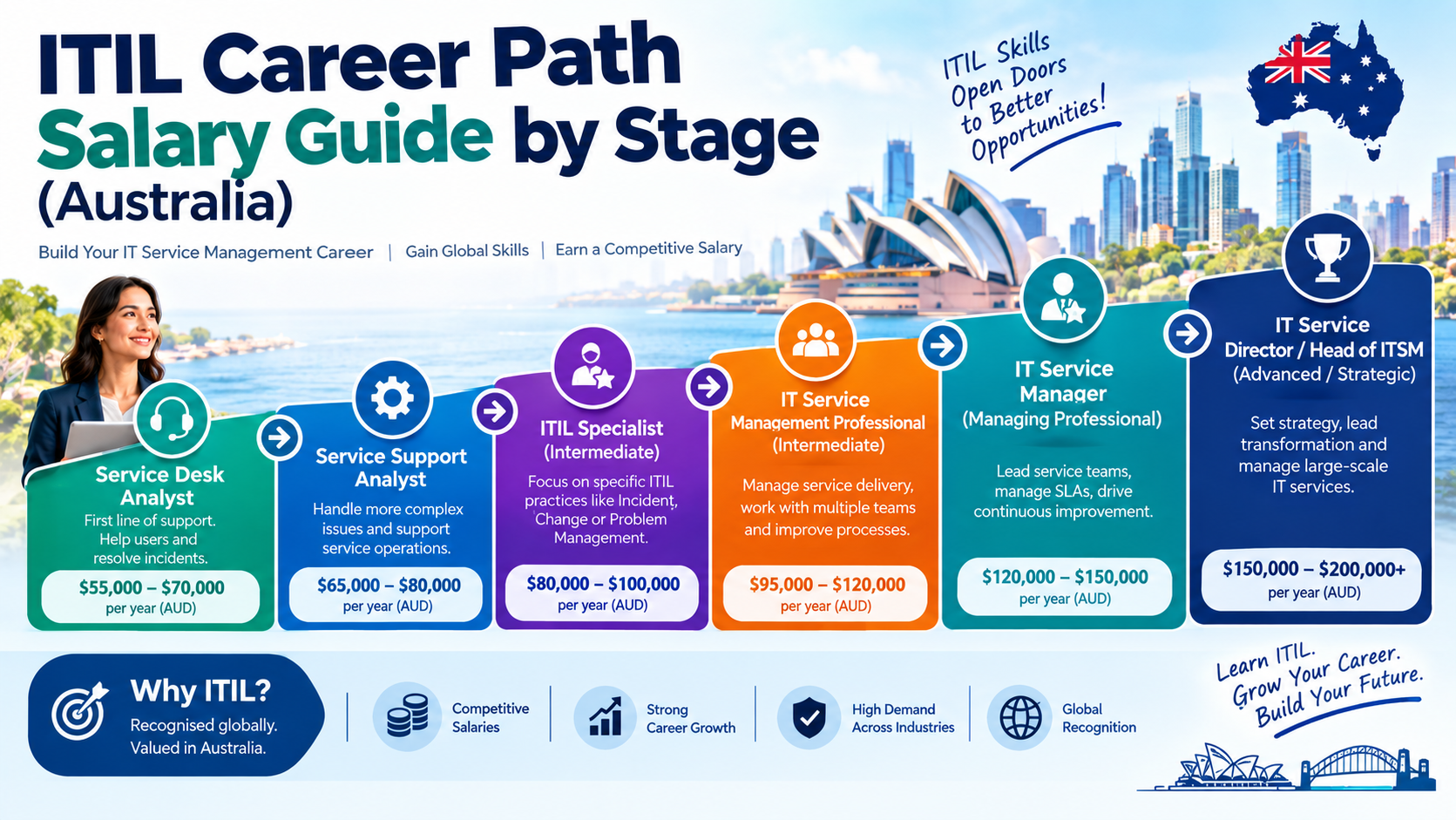
ITIL Career Path Salary Guide by Stage (Australia)
| Stage | Role | Certification | AU Salary Range |
| 1 | Service Desk Analyst | ITIL 4 Foundation | $55,000–$70,000 |
| 2 | Senior Analyst / Team Leader | ITIL 4 Foundation | $70,000–$85,000 |
| 3 | Incident / Problem Manager | ITIL 4 Managing Professional | $95,000–$120,000 |
| 4 | Service Delivery Manager | ITIL 4 Managing Professional | $110,000–$135,000 |
| 5 | IT Service Manager | ITIL 4 Managing Professional | $130,000–$160,000 |
| 6 | Senior IT Service Manager / Head of ITSM | ITIL 4 Strategic Leader | $150,000–$190,000+ |
For a full breakdown by certification level and city, see the ITIL Salary Guide Australia. If you are still weighing up the investment, the ITIL Certification Cost guide breaks down exam fees and ROI at each level.
Skills You Need to Progress Along the ITIL Career Path
- Incident, problem and change management practice knowledge
- Stakeholder communication and executive reporting
- Continual improvement and service value chain thinking
- Vendor and SLA/XLA management
- Familiarity with ITSM tooling (ServiceNow, Jira Service Management, Freshservice)
- People leadership as you move from analyst to manager roles
ITIL Career Path Opportunities Across Australia
Demand for ITIL-certified professionals differs slightly by city, but the career path itself is consistent nationally:
- Sydney — strong demand across finance, government and enterprise IT service desks
- Melbourne — high volume of ITSM roles in healthcare, education and retail
- Brisbane — growing government and infrastructure ITSM teams
- Perth — mining and resources sector service management roles
- Adelaide — defence, government and utilities ITSM positions
- Canberra — federal government ITIL-aligned service management roles
Logitrain delivers ITIL 4 Foundation and Managing Professional training live online across all these cities see logitrain.com.au for the full course calendar.
How Long Does the ITIL Career Path Take?
Moving from Service Desk Analyst to IT Service Manager typically takes 7–10 years, though this can be shortened by combining ITIL 4 certifications with deliberate exposure to incident, problem and change management responsibilities early in your career. Professionals who complete ITIL 4 Managing Professional within their first 3–4 years tend to reach IT Service Manager roles faster than those who rely on Foundation alone.
Frequently Asked Questions
Do I need ITIL certification to start the ITIL career path?
It is not always mandatory for entry-level service desk roles, but ITIL 4 Foundation is increasingly listed as a preferred or required qualification by Australian employers, and it is essential for promotion beyond the service desk.
Can I skip Foundation and go straight to Managing Professional?
No ITIL 4 Managing Professional requires ITIL 4 Foundation as a prerequisite.
What is the fastest route along the ITIL career path?
Completing ITIL 4 Foundation early, taking on incident or problem management responsibilities as soon as possible, and progressing to ITIL 4 Managing Professional within 3–4 years is the fastest verified route.
Is the ITIL career path the same in every industry?
The stages are consistent, but the pace differs regulated industries like finance, government and healthcare in Sydney, Melbourne and Canberra often move service desk staff into management faster due to compliance-driven service management needs.
What should I prepare for an IT Service Manager interview?
Review the ITIL Interview Questions and Answers guide for scenario-based questions covering incident, problem and change management.
Start Your ITIL Career Path Today
Whether you are starting out as a Service Desk Analyst or ready for ITIL 4 Managing Professional, Logitrain runs live online ITIL 4 courses across Sydney, Melbourne, Brisbane, Perth, Adelaide and Canberra. Visit itilcertification.com.au or logitrain.com.au to view upcoming dates and enrol.
Official framework reference: AXELOS / PeopleCert ITIL 4 resources.