





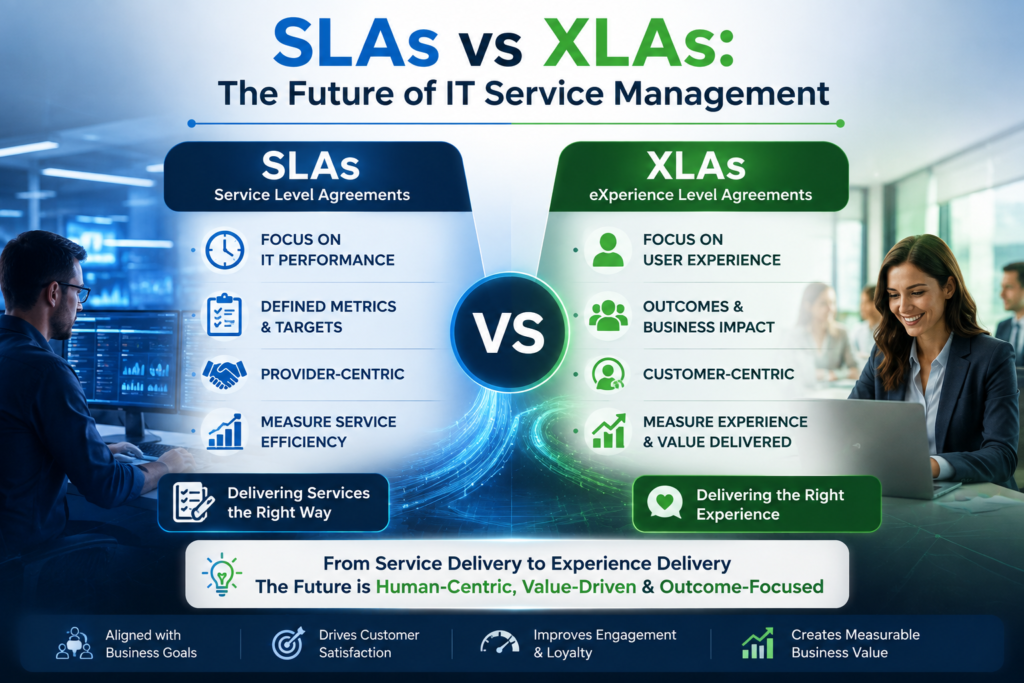
SLA vs XLA is one of the most practical debates in IT service management right now: do you keep measuring support purely against Service Level Agreements, or do you shift toward Experience Level Agreements that measure how the service actually felt to use? For ITIL 4 practitioners in Australia, this isn’t an either/or question it’s about knowing when each model fits, and how to evolve your service level management practice without losing the discipline SLAs provide.
Whether you’re running a service desk in Sydney, Melbourne, Brisbane, Perth, Adelaide or Canberra, the shift from SLA to XLA thinking is showing up in vendor contracts, CAB discussions and customer satisfaction reporting alike.
What Is a Service Level Agreement (SLA)?
A Service Level Agreement is a formal commitment between an IT service provider and a customer that defines measurable targets response times, resolution times, uptime percentages for a given service. Within ITIL 4, SLAs sit inside the service level management practice, which exists to set, monitor and review a service’s level of performance so it consistently meets agreed expectations.
SLAs are essential for accountability. They give a service desk clear, contractual targets, and they give customers a way to hold a provider to account. Their weakness is that they measure outputs — was the ticket closed within four hours not whether the customer actually felt supported.
What Is an Experience Level Agreement (XLA)?
An Experience Level Agreement measures the outcome of a service from the user’s point of view sentiment, ease of use, and whether the service helped someone do their job rather than only the technical delivery metric. Where an SLA might track “incidents resolved within SLA target: 96%”, an XLA might track “employees report feeling productive within 30 minutes of raising an issue.”
XLAs don’t replace SLAs; they sit alongside them. ITIL 4’s focus on value co-creation and the guiding principle to “focus on value” both support this shift a ticket resolved in three hours that leaves the customer frustrated is technically an SLA pass and an experience failure.
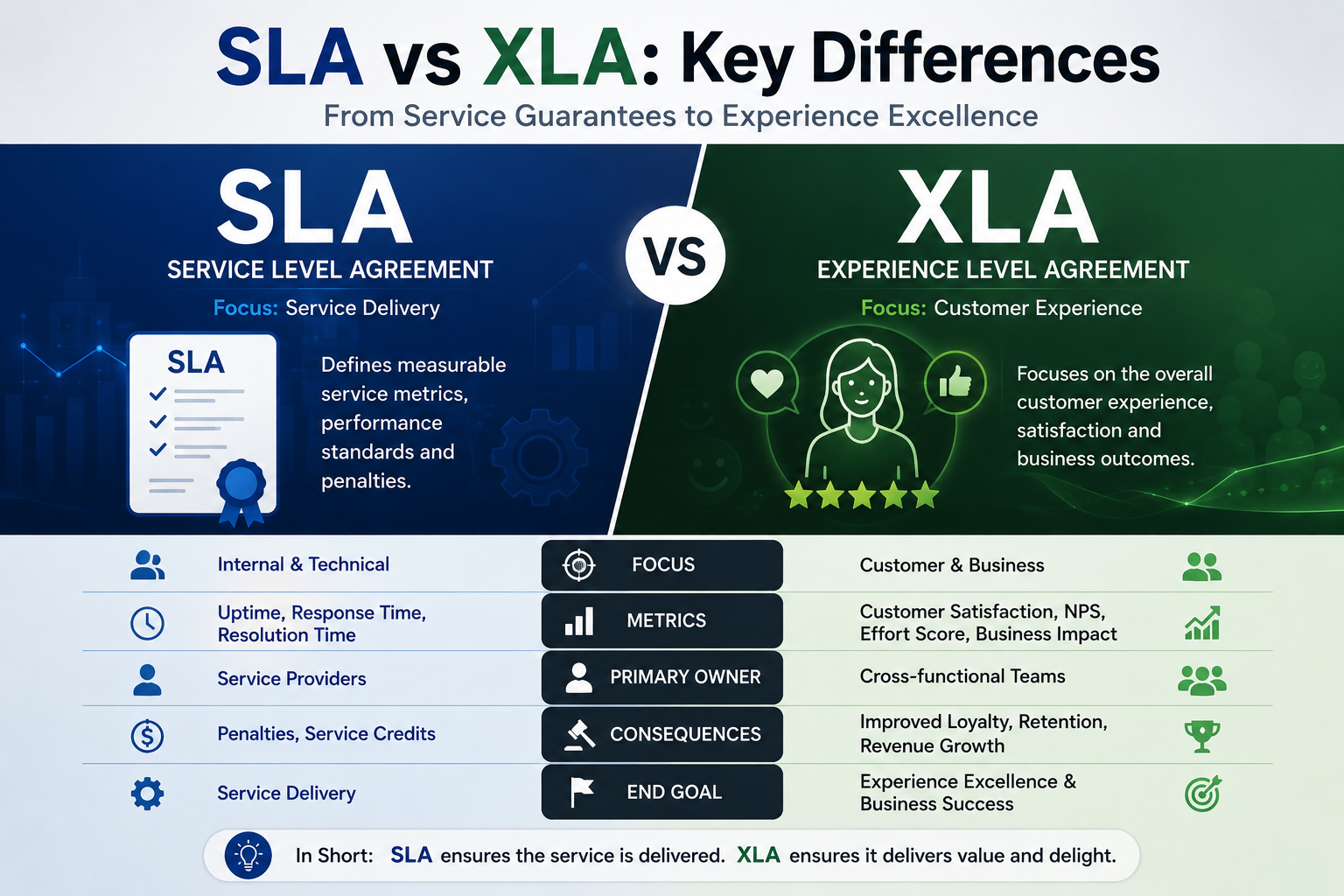
SLA vs XLA: Key Differences
| SLA | XLA | |
| Measures | Technical delivery (response/resolution time, uptime) | User sentiment and outcome (ease, productivity, satisfaction) |
| Data source | Ticketing system timestamps | Surveys, sentiment analysis, digital experience monitoring |
| ITIL 4 practice | Service Level Management | Service Level Management + Relationship Management + Continual Improvement |
| Strength | Clear, contractual, easy to audit | Reflects real perceived value, not just uptime |
| Risk if used alone | “Watermelon SLAs” — green on the report, red for the user | Harder to contract, can feel subjective without good data |
Why XLAs Are Becoming the Future of ITSM
- Employee experience is now a board-level metric, not just an IT one, so leadership wants outcome data, not just uptime reports.
- Hybrid and remote work made “how did this feel to use” as important as “was it fixed on time.”
- ITIL 4’s shift toward value co-creation gives XLAs a natural home inside modern service level management.
- XLA data helps service desks prioritise fixes that actually move satisfaction, rather than chasing metrics that look good but don’t reflect user reality.
Real ITIL Use Case: Moving from SLA-Only to SLA + XLA
A typical maturity path for an ITIL 4 service desk looks like this: start with solid SLAs for the practices that need contractual clarity major incident response, change lead times, request fulfilment — then layer XLA measurement on top for the practices where perception matters most, such as service desk interactions and knowledge article usefulness. Continual improvement then uses both data sets together: SLA breaches tell you what broke, XLA data tells you what to fix first.
This pairs directly with the incident and problem workflows covered in our guide to ITIL Incident Management vs Problem Management, since XLA sentiment data often reveals which recurring problems deserve priority.
Where AI Fits into SLA and XLA Reporting
Generative AI tools are increasingly used to summarise survey comments into themes and flag sentiment trends automatically. We cover this in detail in Microsoft Copilot for IT Service Management, which shows how AI-assisted reporting can turn raw XLA feedback into action items for a service desk without adding manual analysis work.
SLA and XLA Adoption Across Australia
- Sydney and Melbourne — large enterprise IT teams are leading XLA adoption, often piloting it inside a single business unit before rolling out further.
- Brisbane and Perth — resources-sector IT teams are combining SLA uptime targets with XLA sentiment tracking for remote-site support.
- Adelaide and Canberra — government and defence-adjacent teams tend to keep SLAs as the primary contractual mechanism, adding XLA measurement as a secondary improvement layer.
Governance Considerations When Introducing XLAs
- Don’t remove existing SLAs — XLAs are additive, not a replacement for contractual accountability.
- Agree on a small number of XLA metrics first (2–3) rather than trying to measure everything at once.
- Make sure survey and sentiment data collection complies with your organisation’s privacy policy and data retention rules.
- For a broader industry view on experience-based service metrics, see HDI’s IT service management resources, a recognised international ITSM industry body.
How to Build SLA and XLA Skills Through ITIL 4
Service level management, relationship management and continual improvement are all covered inside ITIL 4 Foundation and Managing Professional training the practices that make SLA vs XLA a workable strategy rather than a buzzword.
For the full breakdown of the practices referenced in this article, see our guide to the ITIL 4 Practices.
If you’re building the business case for adding XLA measurement to your team, it’s worth reviewing current ITIL salary benchmarks and ITIL certification costs in Australia, since practitioners who can speak to both SLA and XLA data are increasingly valued.
Explore accredited ITIL and IT service management courses at Logitrain, delivered across Sydney, Melbourne, Brisbane, Perth, Adelaide and Canberra, both in person and online.
Frequently Asked Questions
Is an XLA the same as an SLA?
No. An SLA measures technical delivery, such as response and resolution times. An XLA measures how the service felt to use, based on sentiment and outcome data. Most mature ITIL 4 teams run both together.
Should we replace our SLAs with XLAs?
Not usually. SLAs remain important for contractual accountability. XLAs are best used alongside SLAs to capture the experience side that SLA metrics alone can’t show.
Which ITIL 4 practice covers XLAs?
XLAs sit primarily within Service Level Management, with strong links to Relationship Management and Continual Improvement, since experience data drives ongoing service improvements.
How do I start measuring XLAs on my service desk?
Start with two or three simple sentiment metrics such as ease of resolution and perceived speed collected through short post-ticket surveys, then build from there. Logitrain ITIL courses cover how to fit this into a service level management practice properly.
Conclusion
SLA vs XLA isn’t a competition it’s a maturity step. Service Level Agreements will always matter for contractual accountability, but Experience Level Agreements are quickly becoming the missing half of the picture for Australian ITIL 4 teams that want to know not just whether a ticket was closed on time, but whether the service actually worked for the people using it.