

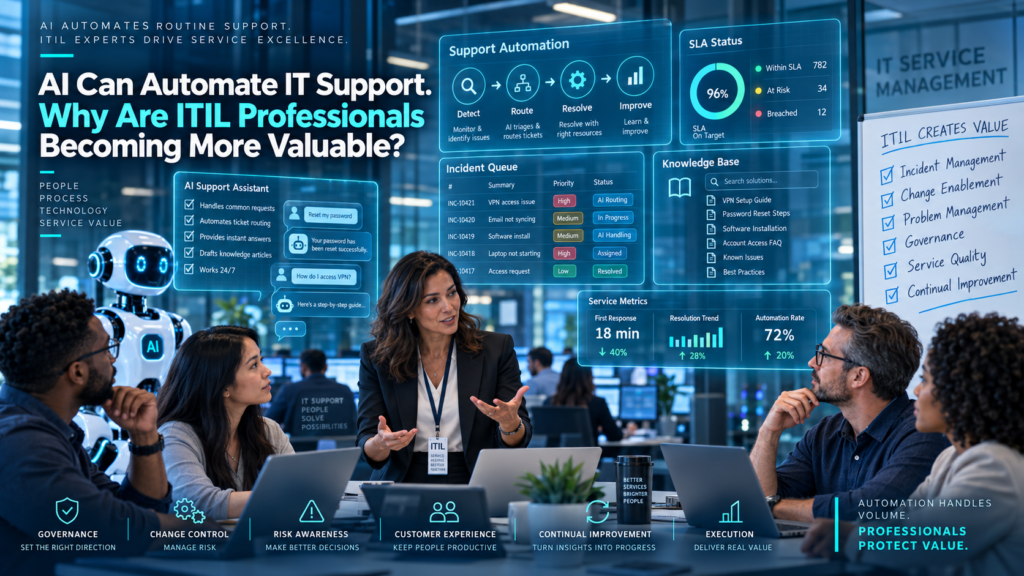

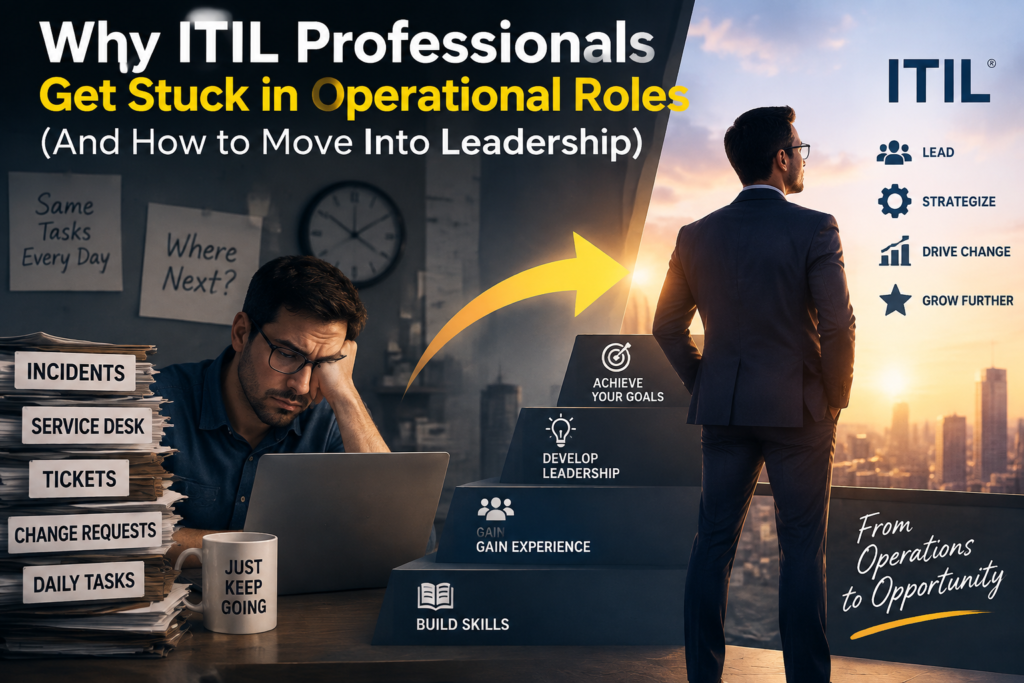
AI can now triage tickets, draft knowledge articles, and resolve simple password resets without a human touching them. So why is ITIL certification becoming more valuable, not less, in a market where automation is supposed to be replacing IT support jobs? The honest answer is that AI is very good at executing tasks and very bad at owning outcomes and ITIL certification is exactly the credential that proves you can do the second part.
As service desks fill up with copilots and AI agents, employers are not looking to cut their ITSM teams. They are looking for ITIL certified professionals who can govern that automation, keep it aligned to business risk, and step in the moment a process needs human judgement. That shift is changing what “valuable” looks like on an IT resume.
Can AI Really Replace IT Support?
AI has genuinely automated a large slice of Tier 0 and Tier 1 work: self-service password resets, access provisioning, ticket categorisation, and first-line troubleshooting scripts. Industry analysts tracking IT service management have been clear that this trend accelerates every year, with generative and agentic AI tools now producing more first-draft support content than human analysts do.
But automation without structure is risky. Gartner’s 2026 Hype Cycle for AI in ITSM projects that a large share of AI-driven service desk initiatives will be abandoned within the next two years because organisations underestimate the governance, data quality, and risk controls needed to run them safely. That gap is precisely where ITIL certification adds value it’s the discipline that stops automation from becoming chaos.
Why AI Automation Increases the Value of ITIL Certification
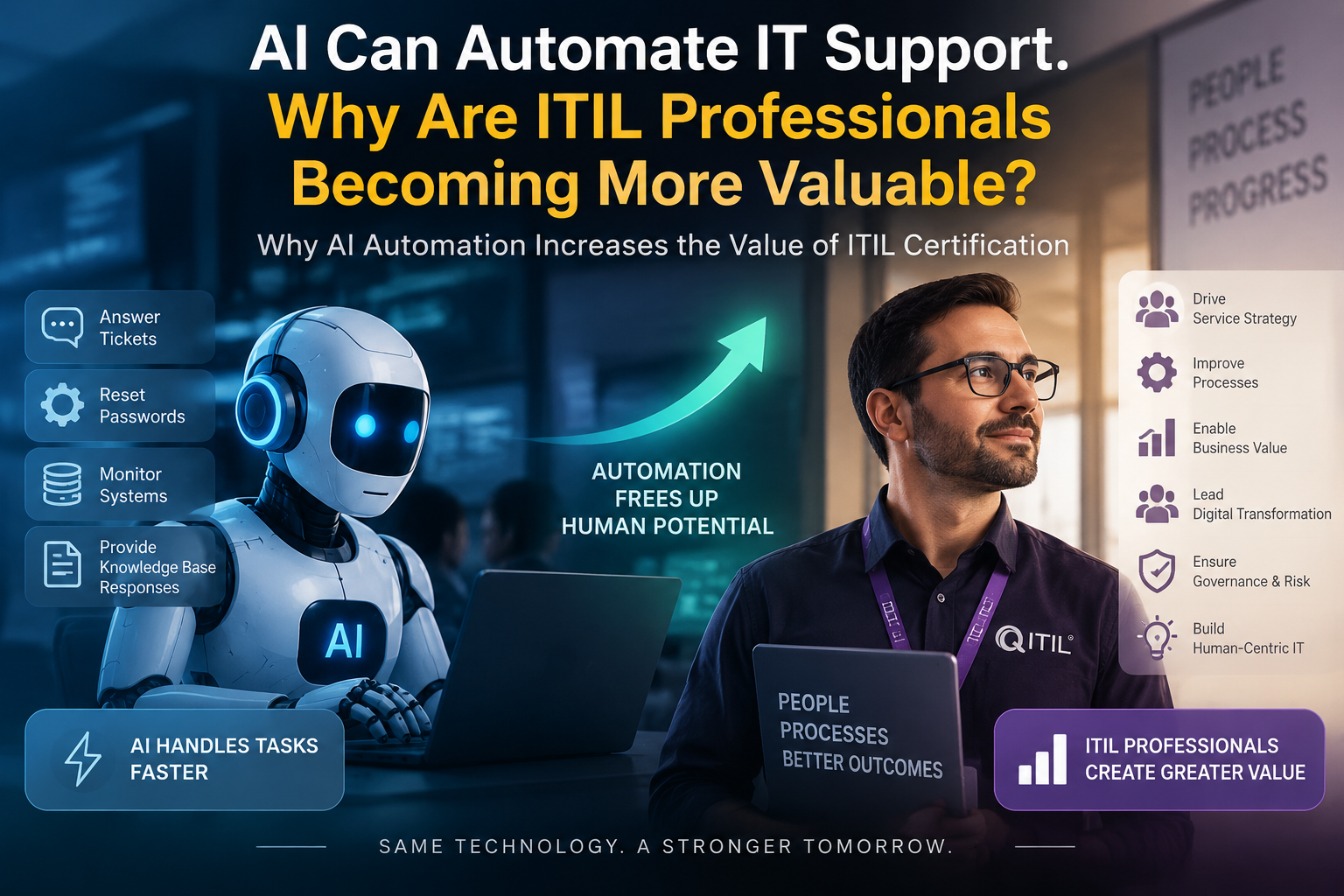
AI Handles Tasks, ITIL Handles Judgement
An AI agent can close a repetitive ticket in seconds, but it cannot decide whether a recurring incident points to a deeper systemic problem, or whether a proposed fix carries unacceptable business risk. ITIL certification trains professionals in exactly this kind of judgement problem management, risk-based decision-making, and service value thinking none of which an automation script can replicate on its own.
Governance and Change Enablement Can’t Be Automated Away
Every AI action inside a live IT environment is still, technically, a change. Someone has to define what an AI agent is allowed to touch, how its actions are logged, and what happens when it gets something wrong. ITIL’s change enablement and service value system practices give organisations that framework, and ITIL certified staff are the ones trusted to design and run it.
AI Needs ITSM Structure to Work Properly
AI tools perform best on top of clean, well-governed ITSM processes accurate configuration data, mature incident categorisation, and a documented service catalogue. Without that foundation, automation simply speeds up bad process. As one 2026 industry analysis of AI in ITSM puts it, AI doesn’t remove the need for service management discipline it increases it, because every automated action still needs oversight, escalation paths, and measurable outcomes. That is ITIL certification territory, not AI territory.
What ITIL Certified Professionals Do That AI Still Can’t
- Interpret ambiguous incidents that don’t match a known pattern and decide the right escalation path
- Balance competing business priorities when an AI recommendation conflicts with operational risk
- Design and govern the change management guardrails that keep AI agents accountable
- Translate technical service performance into business-relevant outcomes for leadership
- Build the continual improvement culture that keeps automation actually improving, not just repeating itself
How to Future-Proof Your IT Career with ITIL Certification
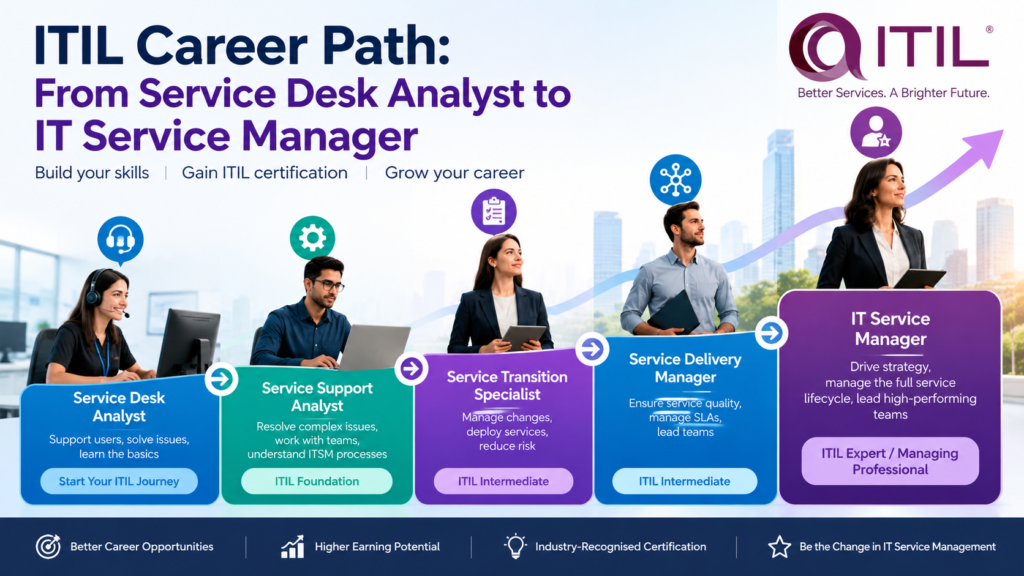
The professionals most exposed to AI disruption are the ones whose entire value was task execution. The professionals becoming more valuable are the ones who can supervise, govern, and improve the systems AI now runs on and that is exactly what an ITIL 4 Foundation Certification is built to teach. From there, professionals aiming for leadership or governance-focused roles typically progress toward the ITIL 4 Managing Professional Designation or the ITIL 4 Strategic Leader pathway, both of which map directly to the oversight and continual-improvement skills AI cannot replicate.
It’s also worth anchoring your learning to the official framework itself the PeopleCert ITIL 4 framework overview outlines exactly how the certification scheme has evolved to account for automation and digital transformation, which is useful context before choosing a course.
ITIL Certification Training Across Australia
Whether you are starting an ITIL certification from scratch or progressing to a managing professional or strategic leader designation, structured instructor-led training closes the gap between passing an exam and being genuinely job-ready. We deliver ITIL certification training online and in person across:
- ITIL certification training in Melbourne
- ITIL certification training in Sydney
- ITIL certification training in Brisbane
- ITIL certification training in Perth
- ITIL certification training in Adelaide
- ITIL certification training in Canberra
Frequently Asked Questions
Will AI eventually replace the need for ITIL certification?
No. AI replaces repetitive task execution, not governance and decision-making. As automation spreads, the demand for ITIL certified professionals who can manage risk, oversight, and service value is increasing rather than shrinking.
Do I need IT experience before starting ITIL certification?
No formal prerequisites are required for the ITIL 4 Foundation Certification, making it accessible to both newcomers and experienced IT professionals adapting to AI-driven service desks.
Which roles benefit most from ITIL certification in an AI-driven IT environment?
Service Desk Analysts, Incident Managers, Change Managers, Service Delivery Managers, IT Operations Managers, and ITSM Consultants all benefit, since each role increasingly involves supervising AI-assisted processes rather than performing manual tasks.
Final Thoughts
AI is not eliminating IT support careers it’s eliminating the parts of the job that never needed a skilled professional in the first place. What’s left is exactly what ITIL certification was designed for: governance, judgement, and continual improvement. Explore our full range of ITIL certification courses or contact our team to plan an ITIL certification path that positions you ahead of automation, not behind it.