


The service ownership gap shows itself at the worst possible moment. It is 6:10 on a Monday morning, the payroll system is down, and an incident channel fills with messages. The infrastructure team says the servers look fine. The application team says it must be the database. The vendor says the issue is on your side. Meanwhile the finance director asks a simple question that nobody can answer: who is in charge of this service?
This guide explains why the service ownership gap exists, what it costs when a critical business service fails, and how to close it. You will also see how ITIL practices and ITIL certification courses give IT teams a shared language for ownership, incidents, problems and change.
Quick answer: nobody knows who is responsible because most IT teams are organised around technology components such as servers, applications and networks, not around the business services that depend on them. The fix is to name one accountable service owner for every critical service, document who does what, build that ownership into your escalation paths and rehearse a failure before a real one happens.
What Is the Service Ownership Gap?
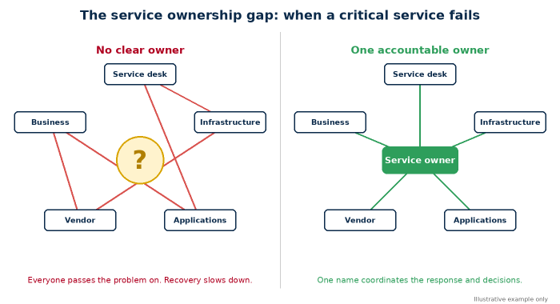
The service ownership gap is the space between a business service and anyone who is clearly accountable for it from end to end. Individual components have owners. The network team owns the network. The database team owns the database. But the service the business actually cares about, such as online ordering, payroll or customer support, runs across all of them, and nobody owns the whole thing.
A good comparison is a relay race with no team captain. Each runner knows their own leg, yet when the baton is dropped, no one is responsible for working out what went wrong, who should pick it up and what to tell the crowd.
What Happens When a Critical Service Fails and Nobody Owns It
When there is a service ownership gap, the same pattern tends to repeat during every major incident:
| Stage | What should happen | What happens with no owner |
| Detect | The right person is alerted immediately | Alerts go to a shared mailbox or the wrong team |
| Triage | Someone decides priority and who leads | Teams argue about whether it is their problem |
| Escalate | The path to senior decision-makers is clear | People guess who to call and lose time |
| Communicate | Business users get regular, accurate updates | Updates are late, inconsistent or missing |
| Recover | Technical teams work to a single plan | Teams fix their own parts without coordination |
| Review | Causes are found and actions are completed | The incident is closed and the same failure returns |
Every extra minute spent working out who is in charge is a minute the service stays down.
Why Nobody Knows Who Is Responsible
The service ownership gap rarely appears because people do not care. It grows from structure and habit.
1. IT is organised around components, not services
Pink Elephant’s article on the missing service owner role explains that IT organisations usually organise around things they can easily identify, such as applications and infrastructure components. Most services span several components, so the whole service has no natural home.
2. Process owners and component owners claim the title
The same article notes that process owners and component owners often end up using the service owner title, even though they only see part of the picture. The result is a name on a spreadsheet without real end-to-end accountability.
3. The role exists on paper but has no authority
Naming a service owner means little if they cannot influence budgets, prioritise fixes or ask other teams for help. Executives sometimes create the role without giving it the power to act.
4. Outsourcing, cloud and vendors blur the lines
When a service relies on a vendor, a managed service provider or a cloud platform, it is easy to assume someone else is responsible. UNSW’s IT Service Ownership Standard takes the opposite view: the service owner stays accountable for the service lifecycle even when the technology or skills are provided by another area.
5. No agreed list of critical services
If the organisation has never listed its business services or rated how critical each one is, there is no way to decide which failures need an owner at all. The UNSW standard assigns each service a criticality rating, from core mission critical to non-critical, and that rating decides which practices are mandatory.
6. Reorganisations and staff turnover
When teams merge, managers move on or contractors leave, services quietly lose their owners. Nobody notices until the next outage.
7. Assuming the service desk owns everything
The service desk is often the first to see an incident, so it inherits the blame. But taking the call is not the same as owning the service. Without a named owner behind it, the desk can only pass the message along.
Service Owner, Process Owner and Delivery Owner: Who Does What?
Closing the service ownership gap starts with clear roles. The titles vary between organisations, but the responsibilities below are widely used. They draw on the UNSW standard and on Atlassian’s overview of incident and problem management roles.
| Role | Typical accountability | Question they answer |
| Service owner | The whole service lifecycle, performance against agreed service levels, approving post-incident reviews and making sure actions are completed | Who is accountable for this service end to end? |
| Delivery owner | The technical response, resolution and major incident coordination, plus managing technical changes | Who is fixing it right now? |
| Business owner | Approving outages and representing business priorities | Which outage can the business accept, and when? |
| Process owner | The design and health of a process such as incident or change management | Is our process working? |
| Problem manager | Investigating the root cause of a recurring problem | Why does this keep happening? |
| Service desk | First contact, logging and routing, and spotting patterns | What are users reporting? |
Atlassian makes a useful point about problems in particular: name a specific owner for each one so investigations do not stall in a backlog while the same incidents keep happening.
The Cost of the Service Ownership Gap
Left alone, the service ownership gap becomes expensive in several ways:
- Longer outages. Time is lost on debate, hand-offs and unclear escalation.
- Repeat failures. Without an owner to approve reviews and chase actions, root causes stay unfixed.
- Blame and burnout. People under pressure start protecting themselves instead of solving the problem.
- Poor communication. Customers and executives get conflicting messages or nothing at all.
- Lost trust. Business leaders conclude that IT cannot be relied on, which makes future investment harder.
- Compliance risk. Auditors and regulators expect to see who is accountable for critical systems.
Warning Signs of a Service Ownership Gap
Not sure whether you have a service ownership gap? Look for these signs:
- During incidents, the first question in the chat is “whose is this?”
- Critical services have no named owner, or the owner has left the company.
- Escalation lists are out of date or only list technical teams.
- The same incident returns every few weeks.
- Post-incident reviews happen, but nobody tracks the actions.
- Business users do not know who to contact about a service.
- Change approvals are slow because nobody can say which service is affected.
How to Close the Service Ownership Gap: Seven Steps
You do not need a major transformation programme. Start small and work through the services that matter most:
- List your business services. Describe them the way the business does, such as “customer billing” or “staff payroll”, not as server names.
- Rate how critical each one is. Ask what would happen to the business if the service were down for an hour, a day or a week, and rank accordingly.
- Name one accountable owner per service. One person, with the authority to make decisions. Shared ownership usually means no ownership.
- Map who does what. Use a simple RACI chart that shows who is Responsible, Accountable, Consulted and Informed for incidents, changes and communication.
- Build ownership into your tools. Put the owner into the service catalogue, runbooks, monitoring alerts and escalation paths so the right person is contacted automatically.
- Rehearse a failure. Run a short tabletop exercise for each critical service. If the room argues about who leads, you have found a gap before a real outage does.
- Close the loop after every incident. Have the service owner approve the review, assign actions and report progress until they are done.
How ITIL Training Helps Close the Service Ownership Gap
ITIL is a widely used framework for IT service management. It gives teams common language and practices for exactly the things that go wrong when ownership is unclear: incident management, problem management, change enablement, service levels and the service catalogue. When everyone in an incident call uses the same terms and understands the same roles, hand-offs get faster and arguments get shorter.
ITIL Certification Australia offers practical IT service management training with globally recognised ITIL certification. According to the site, courses are expert-led and cover incident, problem and change management, and you can study in person in major cities or live online. The current courses listed are:
- ITIL 4 Foundation Certification: the usual starting point for anyone who works with or alongside IT services, from service desk staff to business managers.
- ITIL 4 Managing Professional: for practitioners who plan, deliver and improve IT-enabled services day to day.
- ITIL 4 Strategic Leader: for leaders who shape how technology and services support business direction.
Check each course page for the current syllabus, prerequisites and exam details. Not sure where to begin? Read the FAQs, learn about the provider or browse more articles on the ITIL certification blog.
ITIL Certification Courses Across Australia
Whether you are fixing the service ownership gap in a large department or building skills for your own career, instructor-led training is available in your city:
- ITIL certification Melbourne: in-person and live online.
- ITIL certification Sydney: in-person and live online.
- ITIL certification Brisbane: in-person and live online.
- ITIL certification Perth: live online and in-house.
- ITIL certification Adelaide: live online and in-house.
- ITIL certification Canberra: live online and in-house.
Teams in Hobart and New Zealand can join live online, and in-house training can be arranged for your organisation. See every option on the locations page, then contact the team or call 1300 649 299.
Frequently Asked Questions About the Service Ownership Gap
What is the service ownership gap?
It is the lack of a single, clearly accountable person for a business service from end to end, so nobody is sure who leads when the service fails.
What does a service owner do?
A service owner is accountable for a service across its lifecycle: how it performs, how incidents are handled against agreed service levels, and whether lessons from failures lead to improvements. They do not need to fix the technology themselves.
What is the difference between a service owner and a process owner?
A service owner looks after a specific service for the business. A process owner looks after a process, such as incident or change management, across all services.
Who is responsible when a critical business service goes down?
The service owner is accountable for the outcome, while a delivery or technical lead usually runs the hands-on recovery. If you cannot name both people for a critical service, you have a service ownership gap.
Does ITIL certification cover service ownership?
ITIL training covers service management practices, roles and responsibilities that relate directly to ownership, including incident, problem and change management. Check the course page for the current syllabus.
Final Thoughts
The service ownership gap is not caused by lazy teams. It is caused by structures built around technology instead of services. Pick your most critical service today, name one accountable owner, write down who does what and run a short rehearsal. Then repeat for the next service. When you want your team speaking the same language, explore the ITIL certification courses and build the skills to keep critical services running.