


IT firefighting makes for a great story. A major outage hits at 2 am, the on-call engineer jumps in, the service is back by sunrise, and by morning the whole leadership team knows her name. Now think about the engineer who spent last quarter quietly fixing the flaky patch process that would have caused that outage. Nobody knows her name, because nothing happened.
That’s the uncomfortable truth about IT firefighting: it’s loud, so it gets noticed, while prevention is quiet, so it gets overlooked. Yet prevention is what saves money, protects customers and keeps good people from burning out. In this guide we’ll look at why the gap exists, what it really costs Australian IT teams, and how ITIL 4 practices such as problem management help you make prevention visible and valuable.
What Is IT Firefighting (and Why Do Teams Fall Into It)?
IT firefighting is a pattern of working where a team spends most of its time reacting to urgent incidents instead of removing the causes behind them. The same server fills up, the same integration drops, the same password reset flood arrives every Monday. Each time, someone fixes the symptom, closes the ticket and moves on to the next fire.
Most teams don’t choose this on purpose. It creeps in because the service desk is busy, project deadlines are tight and there’s never a good moment to stop and ask why something keeps breaking. Over time the fires become the job. You’ll usually spot it through a few warning signs:
- The same incidents appear in the ticket queue week after week
- Your best people are permanently “too busy” to work on improvements
- Workarounds live in someone’s head instead of a knowledge base
- Changes regularly cause new incidents
- Success is measured by how fast you respond, not by how rarely you need to
Why IT Firefighting Creates Visibility
Firefighting gets attention for a simple reason: it’s easy to see. A severity-one incident has a bridge call, a timeline, a Slack channel full of updates and a hero at the end. Executives see effort, urgency and a happy ending, and they remember it.
Prevention has the opposite problem. When a problem manager removes a root cause, the result is an absence. There’s no outage to report, no angry customer to calm down and no dramatic recovery. The value is real, but it’s invisible unless somebody deliberately measures it.
Many reporting dashboards make this worse. Metrics like mean time to resolution (MTTR) and tickets closed per analyst reward fast reactions. They say very little about whether the incident should have happened in the first place. A team can look brilliant on paper while quietly fixing the same fault forty times a year.
Why Prevention Creates Value
Unlike IT firefighting, prevention creates value because it removes cost, risk and effort at the source. Every incident you avoid saves the time of the people who would have fixed it, the productivity of the staff who would have waited, and the trust of the customers who would have noticed. Unlike a heroic fix, that saving repeats every month.
| Factor | Firefighting | Prevention |
| Visibility | High, because the drama is easy to see | Low, unless you measure avoided incidents |
| Typical metric | Time to respond and resolve | Repeat incident rate, problem records closed |
| Cost over time | Rises as the same faults recur | Falls as root causes are removed |
| Team morale | Adrenaline, then burnout | Predictable workload, space to improve |
| Customer impact | Frequent disruption, fast recovery | Fewer disruptions overall |
| Career effect | Short-term recognition | Long-term credibility and leadership roles |
The Real Cost of IT Firefighting
The cost of IT firefighting rarely shows up on a single invoice, which is exactly why it goes unchallenged. It’s spread across the business in smaller pieces:
- Repeat incidents. Every recurring fault consumes analyst time again and again.
- Burnout and turnover. Constant urgency wears people down, and replacing skilled staff is expensive.
- Stalled projects. Improvement work gets pushed back because the team is always reacting.
- Technical debt. Quick fixes pile up, making the environment harder to change safely.
- Lost trust. Business users stop believing IT can be stable, so they work around it.
If you want a practical way to put numbers on this, our guide on the calm IT advantage and why stability is a competitive edge shows how stability turns into business value.
How ITIL 4 Turns Prevention into a Daily Practice
ITIL 4 gives teams a shared language for moving beyond IT firefighting. It doesn’t ask you to stop responding to incidents. It asks you to treat each incident as information. Several practices work together here:
- Problem management finds the root cause behind recurring incidents, records known errors and agrees permanent fixes. If you’re unsure how it differs from incident handling, read our breakdown of incident management vs problem management.
- Incident management restores service quickly and captures the details that problem management needs later.
- Change enablement reduces the number of failures caused by poorly assessed changes.
- Monitoring and event management spots early warning signs before users feel them.
- Continual improvement keeps a visible register of improvements so prevention work doesn’t disappear.
These are just five of the 34 practices in the framework. Our overview of the ITIL 4 practices every modern IT team should know explains how they connect.
6 Practical Ways to Move from IT Firefighting to Prevention
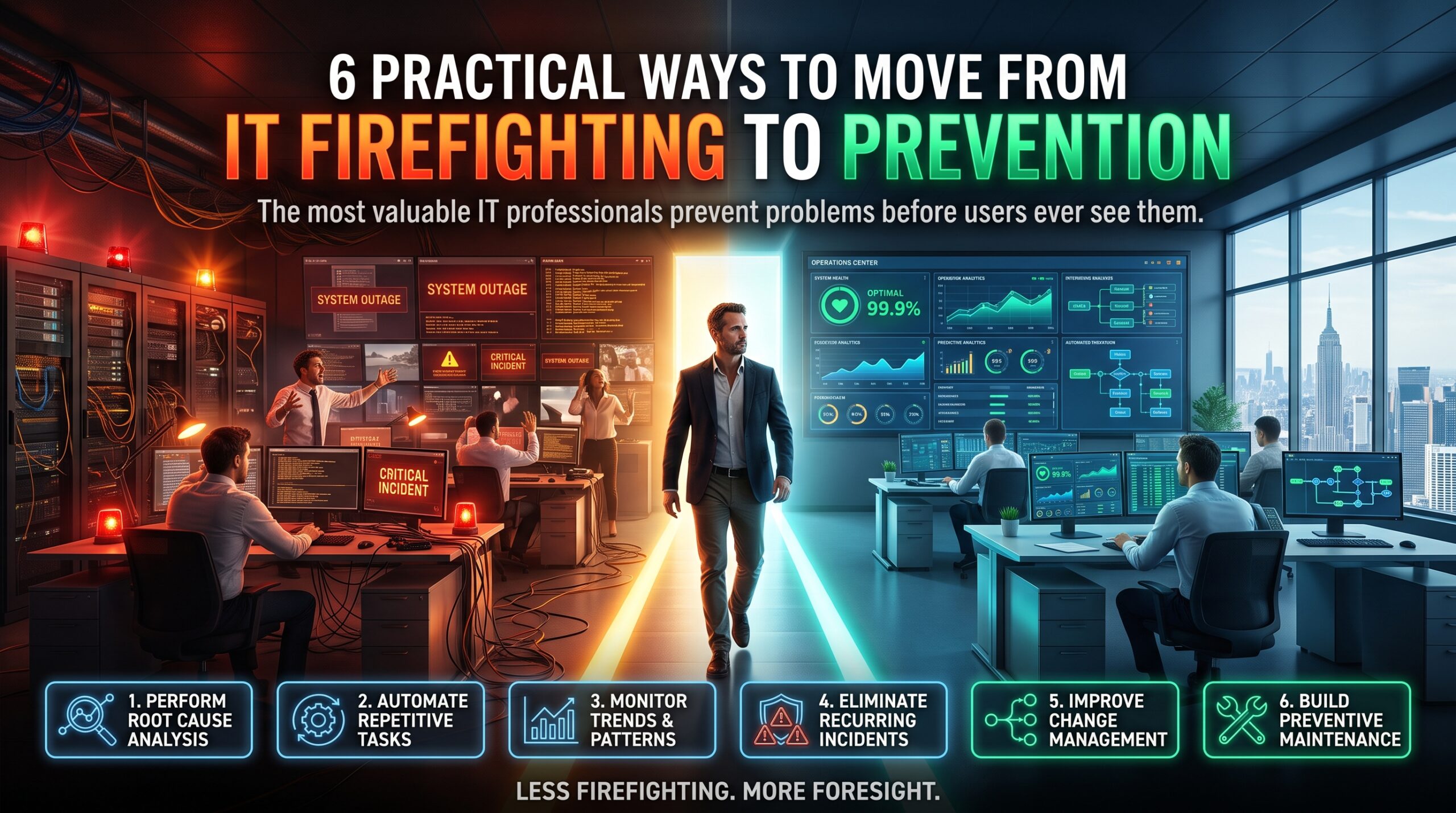
- Track repeat incidents. Group tickets by cause, not just by category. Patterns become obvious within a month.
- Protect time for problem management. Reserve a fixed slice of team capacity every sprint or week, and guard it.
- Run blameless post-incident reviews. Focus on what the system allowed, not who made the mistake.
- Build the knowledge base as you go. Every resolved incident should leave a better article behind it.
- Change what you measure. Add repeat incident rate, problems closed and incidents avoided alongside MTTR.
- Tell the story in business terms. Translate downtime hours into dollars, customer impact and project delays.
How to Make Prevention Visible to Leadership
Prevention only earns respect when people can see it, so give it a story that shows how far you’ve moved beyond IT firefighting. A simple before-and-after is usually enough. For example: “Last quarter, 112 tickets came from one failing VPN gateway setting. We fixed the cause in week three. This quarter, that number is four.” That one sentence shows effort, outcome and value without a single outage.
Keep a short monthly report that shows incidents avoided, hours returned to the business and risks retired. Over time, this changes how leaders see the team. It also helps your own career, because visible impact is what gets reliable people noticed. We cover that in more detail in why reliable IT professionals still get overlooked for promotion.
Why Learning ITIL 4 Helps You Lead the Shift
Moving away from IT firefighting is as much about shared habits as it is about tools. A team that uses the same vocabulary for incidents, problems and changes finds it far easier to agree on priorities. That’s why many organisations send service desk staff and managers through ITIL training together.
- ITIL 4 Foundation gives the whole team a common language for service management, incidents and continual improvement.
- ITIL 4 Managing Professional goes deeper into practical delivery, change and stakeholder engagement.
- ITIL 4 Strategic Leader helps senior leaders connect IT stability to business strategy.
Curious about the return on investment? See the current ITIL certification cost in Australia and the latest ITIL salary guide, or map out your next step with our ITIL career path guide.
ITIL Training in Sydney, Melbourne, Brisbane, Perth, Adelaide and Canberra
You don’t need to leave your city to build these skills. Logitrain runs ITIL courses live online and in the classroom for professionals across Australia, so you can train around work rather than in place of it.
| City | Where ITIL skills help most | Course link |
| Sydney | Large enterprise, finance and telco service desks | ITIL training Sydney |
| Melbourne | Government, healthcare and managed service providers | ITIL training Melbourne |
| Brisbane | Resources, utilities and public sector IT | ITIL training Brisbane |
| Perth | Mining, energy and infrastructure operations | ITIL training Perth |
| Adelaide | Defence, education and growing tech teams | ITIL training Adelaide |
| Canberra | Federal agencies and government contractors | ITIL training Canberra |
Change leaders may also want to explore change management courses, which pair well with ITIL change enablement. For official framework details, the PeopleCert ITIL certification page is the best place to start, and Atlassian’s incident management guide offers a useful vendor-neutral perspective.
Frequently Asked Questions About IT Firefighting
What is IT firefighting?
It’s a reactive way of working where a team spends most of its time fixing urgent incidents instead of removing their root causes. It looks productive, but the same problems keep coming back.
How do you stop IT firefighting?
Start by tracking repeat incidents, protect regular time for problem management, and measure prevention as well as response speed. ITIL 4 provides a clear structure for doing this.
Is reactive IT support ever the right approach?
Yes. Fast incident response is essential when something breaks. The problem is when reaction becomes the only mode of working, with no time left to fix what keeps failing.
Which ITIL course helps with proactive problem management?
ITIL 4 Foundation is the best starting point, while ITIL 4 Managing Professional covers deeper delivery and improvement skills.
How can I prove the value of prevention to my manager?
Report repeat incident rate, problems closed and hours saved each month, and convert downtime into dollars. Numbers make the invisible visible.
Final Thoughts: Choose the Work That Compounds
Heroics will always get applause, and that’s fine. But the teams and people who build long careers are the ones who make the fires stop. If IT firefighting has become your normal, start small: pick the one incident that keeps returning and fix it properly. Then tell people what changed.
Ready to build the skills to do this across your whole team? Explore ITIL 4 training with Logitrain and enrol in a course in your city today.