


Unreliable IT services don’t just cost you a few hours of downtime. They charge a quieter, repeating fee that never appears on an invoice. We call it the operational stress tax: the extra attention, overtime, workarounds and lost trust that everyone pays each time a service wobbles.
A payroll system that freezes every second Friday. A VPN that drops during client calls. A “temporary fix” that has been temporary for two years. Each one looks small. Added together, they drain energy from the people who keep your business running. This article explains where the tax is paid, why it keeps growing, and how ITIL 4 skills help teams bring it down.
What Is the Operational Stress Tax?
Think of it as interest on unfinished reliability work. Every time a service fails and gets patched rather than properly fixed, you take on a small debt. You then pay interest on that debt through interruptions, escalations, apologies and late nights. The longer the cause stays unresolved, the more interest accumulates.
What makes it dangerous is that it’s easy to miss. Individual incidents get closed, dashboards show green, and the monthly report says targets were met. Meanwhile, the people behind the scenes are quietly running hotter than they should. Unreliable IT services feel normal long before anyone calls them a problem.
Where the Operational Stress Tax Gets Paid
The cost isn’t limited to the IT department. It spreads across the organisation in ways that are hard to measure but easy to feel.
| Who pays | What it looks like | Hidden cost |
| Service desk staff | Repeat tickets, after-hours calls, constant context switching | Burnout, turnover and lost knowledge |
| Engineers and operations | Firefighting, emergency changes, skipped planned work | Technical debt grows and projects slip |
| Business users | Workarounds, waiting, double handling of data | Lost productivity and shadow IT |
| Customers | Slow responses, failed transactions, repeated apologies | Lower trust and higher churn |
| Managers and leaders | Escalations, status meetings, vendor disputes | Less time for strategy and improvement |
Notice that the tax lands hardest on people who rarely get credit for preventing problems. That’s why it often continues unchecked for years.
Why Unreliable IT Services Keep Happening
Most unreliable IT services aren’t caused by a single dramatic failure. They come from small, repeated gaps in how work is managed. These five turn up again and again:
- Repeat incidents with no root cause work. Teams restore service quickly, then move on. Without problem management, the same fault returns next month.
- Unmanaged change. Rushed or poorly assessed changes are a classic source of outages, especially when no one checks dependencies.
- Alert noise. When everything pings, people stop listening. Real warnings get buried under routine alerts.
- Targets that hide the pain. An SLA can be met while users are frustrated. Raw uptime doesn’t show how the service actually feels.
- Knowledge that lives in heads. If only one person knows the fix, every absence turns into an incident.
Each of these is a process problem, not a people problem, and unreliable IT services are usually the visible result. And process problems are exactly what ITIL was designed to solve.
Warning Signs Your Team Is Paying the Tax
You may already be paying more than you realise. Watch for these signs:
- The same five or six issues dominate your ticket queue every month
- Good engineers are leaving, or talking about leaving, after on-call periods
- “Workaround” has become a normal word in team meetings
- Planned improvement work keeps getting pushed back by urgent fixes
- Business teams have stopped logging tickets and now message individuals directly
If three or more feel familiar, your organisation is likely carrying a real operational stress tax, even if headline uptime looks healthy.
The Real Cost of Unreliable IT Services Beyond Downtime
Downtime is the cost everyone can see. The costs around it are usually larger. When unreliable IT services force people to stop, retry and double-check, the loss shows up as slower decisions, delayed projects and customers who quietly try someone else.
There is also a compounding effect. A tired service desk makes more mistakes. More mistakes create more incidents. More incidents create more tired people. Without a deliberate break in that loop, the operational stress tax grows on its own, even if your infrastructure stays exactly the same.
Leaders sometimes treat this as a morale issue to be solved with pizza and thank-you emails. Kindness helps, but it doesn’t change the cause. The lasting fix is to reduce the number of avoidable incidents so people can spend their energy on work that moves the business forward.
How to Make the Case to Leadership
Decision-makers rarely respond to “we’re stressed”. They respond to clear, comparable numbers. Here is a simple way to frame the conversation:
- Count repeat incidents. Show how many tickets in the last quarter came from the same ten causes.
- Estimate lost hours. Multiply the time spent on repeat fixes by a realistic hourly rate for the people involved.
- Link to business impact. Point to delayed projects, customer complaints or missed targets tied to unreliable IT services.
- Propose a small first step. Ask for protected time to investigate the top five causes rather than a large budget.
Framed this way, reliability work stops looking like a cost centre and starts looking like a way to get time, money and trust back.
How ITIL 4 Reduces Unreliable IT Services
ITIL 4 gives teams a shared language and a set of practices for building dependable services. You don’t need to adopt all of it at once. Even a few practices, applied consistently, start to lower the tax. The table below shows how key ITIL 4 practices target the causes above.
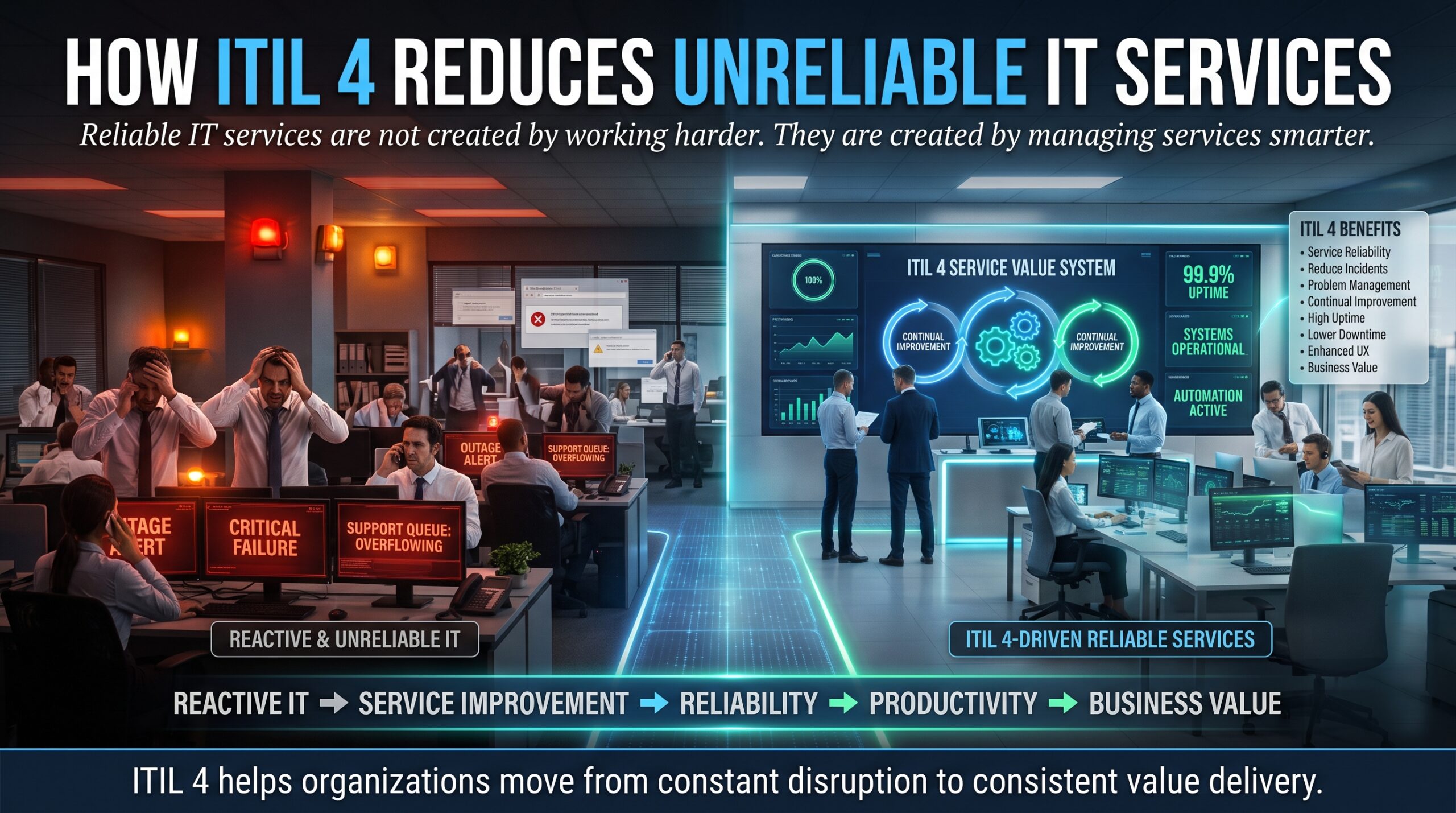
| ITIL 4 practice | What it removes | Typical result |
| Incident management | Slow, inconsistent restoration | Faster recovery and calmer escalations |
| Problem management | Repeat incidents and unknown causes | Fewer recurring tickets |
| Change enablement | Risky, poorly assessed changes | Fewer change-related outages |
| Monitoring and event management | Alert noise and missed warnings | Earlier, clearer signals |
| Service level management | Targets disconnected from user experience | Goals that reflect real service quality |
| Knowledge management | Single points of failure in people | Faster, more consistent fixes |
| Continual improvement | Reliability work that never gets scheduled | Steady, visible progress |
Our ITIL 4 Foundation certification is the best starting point. It introduces the Service Value System and the core practices in plain, workplace-focused language.
A Practical 90-Day Plan to Fix Unreliable IT Services
- Find your top repeat offenders. Pull the last three months of tickets and list the ten most frequent causes. This is your starting map.
- Open problem records. Assign an owner to each of the top five repeat issues and give them time to investigate root causes.
- Tidy your alerts. Remove or merge alerts nobody acts on. Fewer, better alerts help people spot genuine risk.
- Review change habits. Check recent failed or emergency changes. Add a simple risk check before the next release.
- Capture knowledge. Turn the five most common fixes into short, searchable articles.
- Measure experience, not just uptime. Ask users how services feel, then track that alongside your SLAs.
None of this needs a big project budget. It needs consistent attention and shared practices, which is why structured training often speeds things up.
Unreliable IT Services Across Australian Cities
Unreliable IT services have similar causes everywhere, but the pressure points differ by region and industry.
Sydney: Large finance and enterprise environments feel the tax through change volume and strict compliance expectations. See our ITIL training in Sydney.
Melbourne: Healthcare, education and state government services depend on reliable systems around the clock. Explore ITIL certification in Melbourne.
Brisbane: Growth in construction, logistics and infrastructure puts pressure on lean IT teams. Check ITIL courses in Brisbane.
Perth: Mining and energy operations often run remote sites where outages are costly and hard to fix quickly. Learn about ITIL training in Perth.
Adelaide: Defence, health and manufacturing teams benefit from clear incident and change routines. Visit ITIL courses in Adelaide.
Canberra: Government agencies need dependable service delivery and clear accountability. View ITIL certification in Canberra.
Outside these cities, live online classes make ITIL training accessible from anywhere in Australia.
Not sure which level fits? Browse all ITIL certifications or speak with our team.
Common Mistakes When Fixing Unreliable IT Services
- Celebrating heroic fixes. Rewarding firefighting makes prevention look boring. Recognise the people who stop incidents from happening.
- Buying tools before fixing habits. A new monitoring platform won’t help if no one owns the follow-up.
- Closing tickets without learning. Every major incident should end with a short review and at least one change.
- Ignoring the human cost. Staff fatigue is a leading indicator. Treat it as seriously as a failing server.
- Trying to fix everything at once. Start with the top repeat issues and build momentum.
Frequently Asked Questions About Unreliable IT Services
What causes unreliable IT services?
Common causes include repeat incidents with no root cause analysis, poorly managed change, too many low-value alerts, undocumented knowledge and targets that miss the real user experience.
What is the operational stress tax?
It’s the ongoing, often invisible cost of unreliable services: extra effort, interruptions, workarounds, staff fatigue and lost trust. It builds up whenever problems are patched rather than permanently fixed.
How can ITIL help improve IT service reliability?
ITIL 4 provides practices such as incident, problem and change management that help teams restore service faster, find root causes and reduce risky changes. Applied consistently, they lower repeat failures.
Which ITIL certification should I start with?
Most people begin with ITIL 4 Foundation. Managers and team leaders often continue to ITIL 4 Managing Professional, while senior leaders may consider ITIL 4 Strategic Leader.
Where can I do ITIL training in Australia?
Logitrain-backed ITIL training is available in Sydney, Melbourne, Brisbane, Perth, Adelaide and Canberra, as well as live online. See our locations page for details.
Final Thoughts: Stop Paying the Tax, Start Building Reliability
Unreliable IT services rarely collapse in one dramatic moment. They wear people down slowly, one workaround at a time. The good news is that the tax can be reduced with clear practices, honest measurement and a team that has the skills to fix causes, not just symptoms.
Ready to build those skills? Explore our ITIL certification courses, or call 1300 649 299 to talk with a course advisor about the right pathway for you.