


Escalation culture is what happens when an IT team gets better at rescuing situations than at stopping them. The phone rings, a ticket jumps to level two, a manager joins a bridge call, and by Friday everybody feels productive. Then Monday arrives and the same fault is back, wearing a new ticket number. If that rhythm feels familiar, you are not failing at your job. You are working inside a system that quietly rewards the rescue and overlooks the prevention.
This guide explains what escalation culture really is, why it takes hold in Australian IT teams, what it costs the business, and how practices from ITIL 4 help you move effort from reacting to preventing. Whether you run a service desk in Sydney, a managed service team in Melbourne or an operations group in Canberra, the pattern is surprisingly consistent.
What Is Escalation Culture in IT Service Management?
In IT service management (ITSM), escalation simply means moving an issue to someone with more skill or more authority. Passing a faulty database ticket to a specialist is functional escalation. Telling a senior manager that a major incident is breaching its target is hierarchical escalation. Both are normal, healthy parts of incident management.
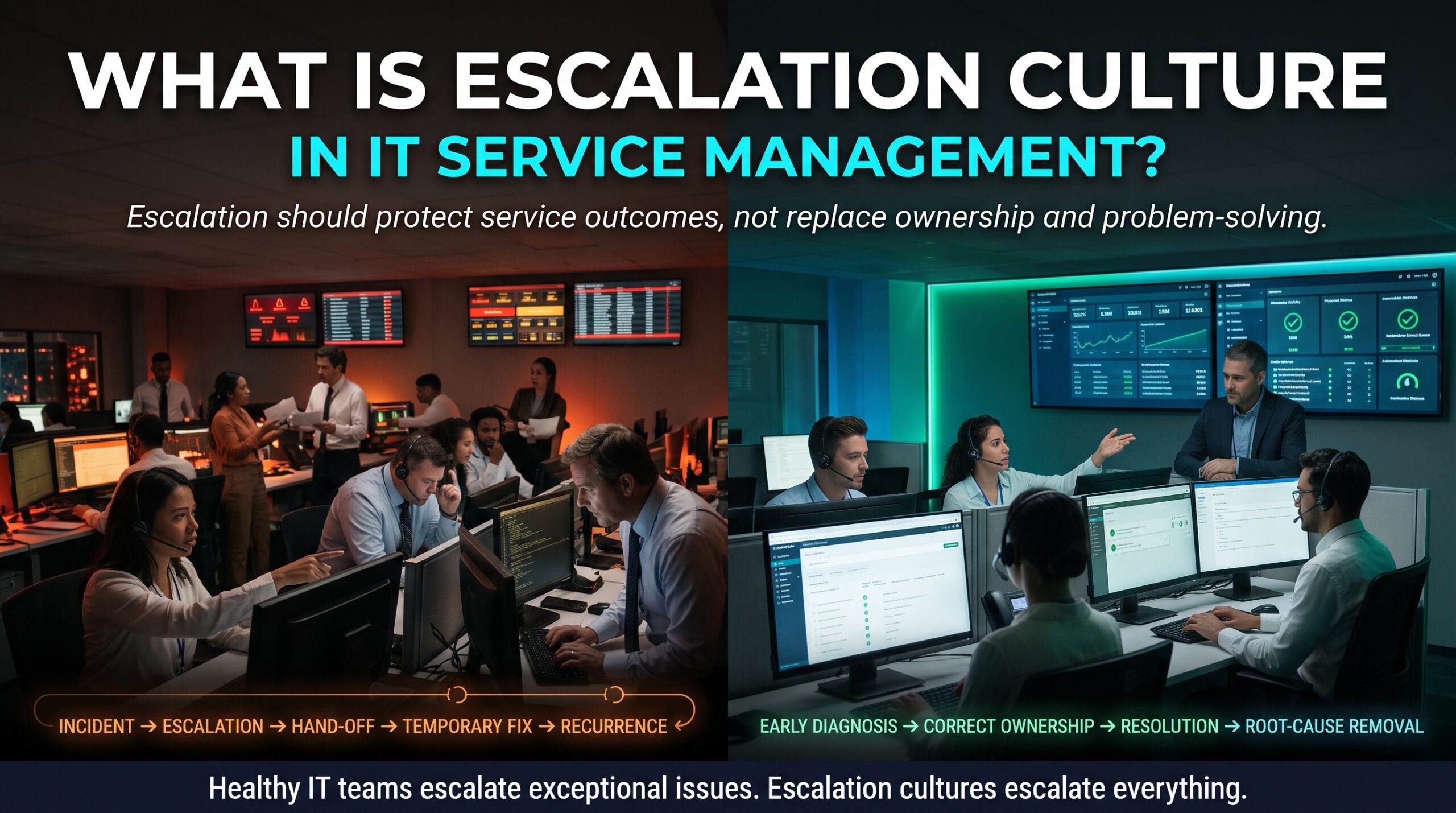
Escalation culture starts when escalation stops being the exception and becomes the default way work gets done. People escalate because it feels safe, because it gets attention, or because nobody has time to look at why the issue keeps happening. Over months, escalation culture teaches the organisation that loud problems get resources and quiet prevention does not.
| Area | Healthy escalation | Escalation culture |
| Purpose | Gets the right skills on a hard problem quickly | Passes responsibility upward to stay safe |
| Frequency | Occasional, for genuinely complex or major incidents | Constant, even for known and repeatable faults |
| After the fix | A review finds the cause and records learning | The ticket closes and the team moves on |
| Who is praised | The team that prevents recurrence | The hero who saved the day again |
| Senior staff time | Spent on strategy and improvement | Spent on bridge calls and chasing updates |
Why Solving Issues Became More Common Than Preventing Them
Nobody sets out to build an escalation culture. It grows from a handful of reasonable-looking habits that compound over time.
Urgent work always beats important work
A failed payment system demands action today. A recurring performance dip that “only” affects a few users can wait until next quarter. Prevention work is rarely urgent, so it is rarely scheduled, and the backlog of root causes quietly grows.
Heroes are visible, prevention is invisible
When an engineer fixes an outage at 2am, everyone sees it. When another engineer spends a week removing the cause so the outage never happens, nobody notices because nothing happened. Managers promote what they can see, and the culture follows the promotions.
Metrics reward speed, not recurrence
Many service desks are measured on tickets closed and mean time to resolve. Those numbers matter, but on their own they reward fast patching. A team can post excellent response times while fixing the same fault forty times a year.
Problem management is starved of time
ITIL separates incident management (restore service) from problem management (find and remove the underlying cause). In escalation-heavy teams, problem management is the first thing dropped when the queue grows, which means the queue grows even faster next month.
Knowledge stays in people’s heads
If the fix lives only in one senior engineer’s memory, every repeat of the issue must travel to that person. Weak knowledge management turns a handful of experts into a permanent bottleneck.
Blame makes escalation feel safer
In teams where mistakes are punished, escalating is self-protection. If a manager approved the decision, the analyst is covered. Google’s engineering teams describe the opposite approach in their guidance on blameless postmortem culture, where the focus is on fixing systems rather than finding someone to blame.
The Real Cost of an Escalation-Driven Team
The damage from escalation culture rarely shows up as one dramatic number. It leaks out through several channels at once, which is exactly why leaders underestimate it.
| Cost area | What it looks like day to day | Business impact |
| Repeat incidents | The same fault reopens every few weeks | Lost productivity and eroding user trust |
| Senior engineer time | Experts pulled into routine firefighting | Strategic and improvement work stalls |
| Team wellbeing | On-call fatigue, constant context switching | Burnout, absenteeism and staff turnover |
| Change failures | Rushed fixes introduced without proper assessment | New incidents caused by the fix itself |
| Customer experience | Users hear “we are looking into it” again and again | Lower satisfaction and weaker renewals |
| Career growth | Prevention skills never get developed | Talented people leave for better environments |
Atlassian’s overview of modern incident management makes the same point from a tooling angle: detecting and responding quickly is only half the job, and learning from each incident is what reduces the next one.
Seven Warning Signs You Have an Escalation Culture
- The same incidents reopen or get logged again within weeks.
- Managers join bridge calls weekly for issues that are not truly major.
- Problem records stay open for months with no owner or next step.
- Level one analysts are nervous about closing tickets without approval.
- Post-incident reviews are skipped because “we are too busy”.
- The same two or three people are always the final point of contact.
- Dashboards celebrate closure speed but never show repeat incident rates.
If three or more of these ring true, your escalation culture is probably not a skills problem. It is a system problem, and that is good news because systems can be redesigned.
How ITIL 4 Helps You Prevent Instead of Escalate
ITIL 4, published by AXELOS and now managed by PeopleCert, is built around a Service Value System rather than a rigid list of processes. Its guiding principles (focus on value, start where you are, progress iteratively, collaborate, think holistically, keep it simple and optimise and automate) fit the escalation culture problem almost perfectly. Here is how specific ITIL 4 practices counter escalation culture.
| ITIL 4 practice | How it reduces escalation culture |
| Incident Management | Defines clear categories, priorities and escalation paths so only genuine major incidents climb the ladder |
| Problem Management | Gives recurring issues an owner, a root cause investigation and a permanent fix |
| Knowledge Management | Captures known fixes so level one can resolve what used to need a specialist |
| Change Enablement | Assesses risk properly so rushed fixes stop creating new incidents |
| Monitoring and Event Management | Spots warning signs early, before users raise a ticket |
| Service Level Management | Aligns targets with business outcomes, not just closure speed |
| Continual Improvement | Makes prevention a regular, funded activity rather than a good intention |
If your team is new to the framework, the ITIL 4 Foundation certification is the natural starting point. It gives everyone, from service desk analysts to team leaders, a shared language for incidents, problems and improvement. You can also explore the broader ITIL certification pathway to see how Foundation leads into the Managing Professional and Strategic Leader levels.
A Practical 90-Day Plan to Reduce Escalations
You do not need a transformation programme to start tackling escalation culture. A focused ninety days is enough to prove that prevention pays for itself.
- Days 1 to 30, measure honestly. Pull the last six months of tickets. Count repeat incidents, escalation rates and how many senior hours went into routine issues. Pick the top five recurring faults.
- Days 31 to 60, fix the top five at the root. Open a problem record for each one with a named owner. Run a short, blameless review and record the permanent fix or workaround in your knowledge base.
- Days 61 to 90, make it stick. Add repeat incident rate and knowledge article reuse to your dashboard. Set simple escalation rules so level one knows exactly when to escalate and when to resolve.
- Then repeat the cycle. Pick the next five faults. Prevention becomes a habit instead of a project.
How Leaders Can Reward Prevention
Escalation culture follows what leaders measure and celebrate. A few small changes send a strong signal.
- Track new metrics: repeat incident rate, escalation rate, first contact resolution and problem records closed.
- Recognise the quiet wins: thank the person who removed a recurring fault just as loudly as the person who fixed the outage.
- Protect improvement time: reserve a fixed share of each sprint or week for problem management.
- Make reviews blameless: ask what the system allowed, not who made the mistake.
- Invest in capability: leaders who understand service management design better incentives. The ITIL 4 Managing Professional designation and ITIL 4 Strategic Leader pathway are built for exactly this.
ITIL Training for Escalation-Heavy Teams in Australian Cities
Training works best when a whole team learns the same language together, because escalation culture is a team habit, not an individual one. Logitrain delivers instructor-led ITIL training through live online sessions across Australia, with classroom options in selected cities and in-house delivery for teams.
- Sydney: ITIL certification in Sydney suits enterprise service desks and finance sector teams. See also the Sydney IT course listings.
- Melbourne: ITIL training in Melbourne is popular with managed service providers and government departments. Browse Melbourne IT courses.
- Brisbane: ITIL certification in Brisbane fits resources, healthcare and education IT teams. View Brisbane IT training.
- Perth: ITIL training in Perth is a strong match for mining and engineering support teams. See Perth IT courses.
- Adelaide: ITIL certification in Adelaide works well for defence and public sector operations. Check Adelaide IT courses.
- Canberra: ITIL training in Canberra serves federal agencies that need consistent service management practice. Visit Canberra IT courses.
You can also compare the full Logitrain ITIL course range or read more on the ITIL 4 Foundation course page at Logitrain.
Frequently Asked Questions About Escalation Culture
What is escalation culture in IT?
It is an operating habit where escalating issues upward becomes the normal response instead of an exception. Teams spend most of their energy resolving repeat problems and very little on preventing them.
Is escalation always a bad thing?
No. Functional and hierarchical escalation are essential for complex and major incidents. It becomes a problem only when it replaces root cause analysis and proper knowledge sharing.
How does ITIL help reduce escalation culture?
ITIL 4 gives teams structured practices for incident, problem, knowledge and change management, plus a continual improvement model. Together these help resolve more issues at the first line and stop repeat incidents at the source.
Which ITIL certification should I start with?
Most professionals begin with ITIL 4 Foundation. Team leaders and managers who want to redesign how their department works often continue to Managing Professional or Strategic Leader.
Can ITIL training be done online in Australia?
Yes. Live online instructor-led sessions run across Australian time zones, and in-house training can be arranged for whole teams in Sydney, Melbourne, Brisbane, Perth, Adelaide and Canberra.
Final Thoughts: Make Prevention the Default
Escalation culture is not a character flaw in your people. It is the predictable result of rewarding rescue more than prevention. The fix is not working harder, it is changing what you measure, what you recognise and what skills your team shares.
Ready to move your team from firefighting to prevention? Contact the ITIL Certification team or call 1300 649 299 to find the right ITIL 4 course for your role and city.