




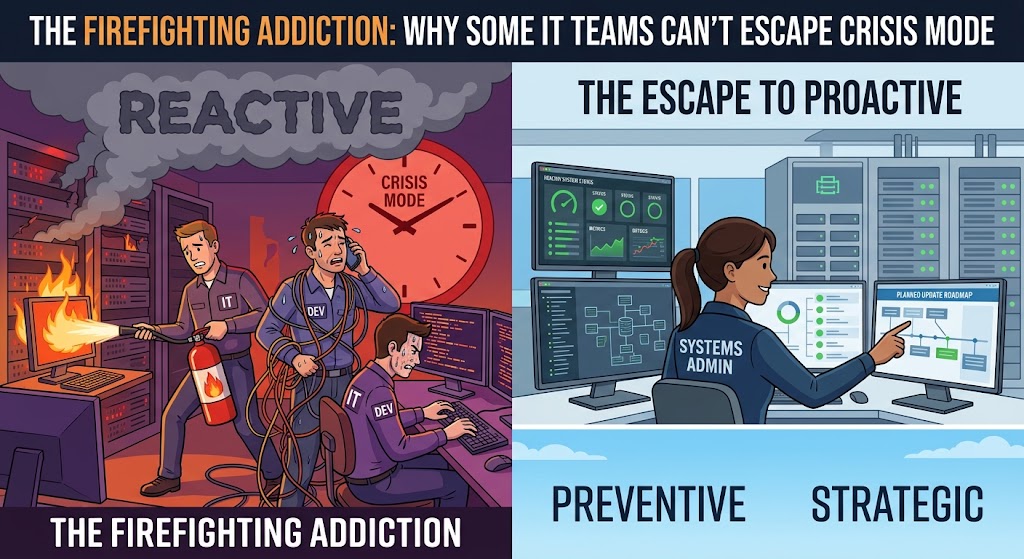
Proactive problem management is one of the most valuable things an IT team can do, and one of the least rewarded.
Picture two engineers. One spends a weekend rescuing a failed system, gets thanked by the executive team and is mentioned in the all-staff email. The other spent the previous quarter finding and fixing the weakness that would have caused the failure. Nobody notices. Nothing happened, and that’s exactly the point. Guess which one gets the promotion.
This guide explains why organisations reward firefighting over prevention, what it costs them, and how IT professionals and leaders can fix the incentives. It’s written for service desk analysts, incident and change managers, IT operations leads and executives across Australia, from Sydney, Melbourne, Brisbane, Perth, Adelaide or Canberra.
Why Proactive Problem Management Gets Less Credit Than Firefighting
In ITIL terms, incident management restores service as quickly as possible, while problem management finds and removes the underlying causes so the same incidents don’t keep returning. Both matter. But only one of them makes a dramatic story.
A crisis has a beginning, a villain, a hero and a happy ending. Prevention has none of that. When proactive problem management works, the result is an absence: no outage, no panic, no late-night bridge call. It’s hard to celebrate something that never happened, so organisations quietly stop noticing it.
7 Reasons Organisations Reward Crisis Management Over Proactive Problem Management
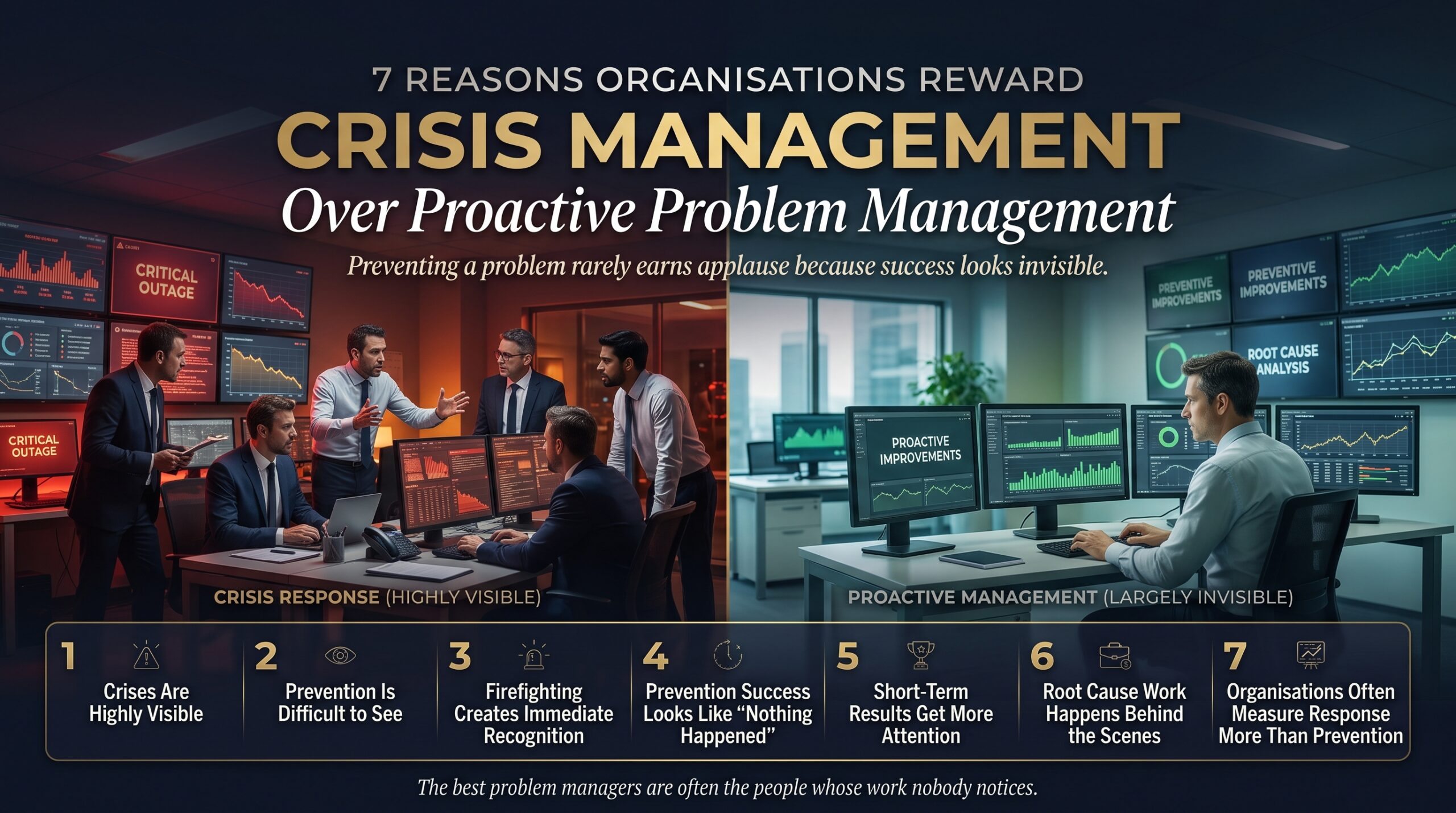
1. Crises are visible. Prevention is invisible.
Executives see the outage, the customer complaints and the recovery. They can’t see the ten outages that didn’t occur. What leaders can see is what they reward.
2. Heroes make better stories
People remember the person who saved the day. Rescue stories travel through the organisation in a way that “we reviewed the logs and fixed a configuration” never will.
3. Metrics measure response, not avoidance
Many dashboards focus on how fast tickets are resolved. Those numbers are useful, but they reward quick recovery rather than fewer incidents. If you only count the fires put out, you’ll never count the fires prevented.
4. Budgets follow pain
Funding for monitoring, redundancy and root cause analysis often appears right after a major outage and disappears when memories fade. Prevention gets paid for in a panic, not in a plan.
5. Promotions follow visible impact
When performance reviews ask “what did you deliver?”, a dramatic recovery beats a quiet improvement. Smart people notice, and they adjust their behaviour accordingly.
6. Short-term thinking wins
Quarterly targets reward this month’s results. Preventing a problem that might hit next year doesn’t help this quarter’s scorecard.
7. Nobody owns the recurring problem
Everyone owns the incident in front of them, so nobody owns the pattern behind it. Without a clear owner, repeated incidents become “just how things are”.
The Real Cost of Ignoring Proactive Problem Management
Rewarding the wrong behaviour creates a loop. Teams get good at recovering and never get time to improve. The same faults come back, the same people stay up late, and leaders conclude that “IT is always in crisis”.
- Repeat incidents. The same root cause keeps generating tickets, eating hours that could go into improvement.
- Constant rescue work wears down your best people, and they leave.
- Key-person risk. When one hero holds the knowledge, a single resignation becomes a crisis of its own.
- Fragile systems. Workarounds pile up and the environment becomes harder to change safely.
- Lost trust. Customers and colleagues remember outages more clearly than quick fixes.
- Security exposure. Unresolved weaknesses are the same ones attackers look for. The Australian Cyber Security Centre publishes guidance on strengthening resilience.
Here’s the uncomfortable truth: a team that is constantly rescued from crises is a team whose proactive problem management has been starved. The fires aren’t proof of hard work. Often they’re proof of missing prevention.
How to Make Proactive Problem Management Visible and Valued
The fix isn’t to stop thanking people who handle crises. It’s to make prevention just as easy to see. Try these changes:
Measure what you want more of
Track repeat incidents, the number of known errors resolved, time spent on root cause analysis and incident trends by category. When those numbers appear on the same dashboard as response times, proactive problem management stops being invisible.
Tell the “nothing happened” story
After a successful fix, write a short note: what the risk was, what you changed and what it could have cost. Label estimates as estimates, but make the avoided problem real. Share it with leadership.
Run blameless post-incident reviews
Reviews that focus on causes rather than culprits give teams the confidence to surface weaknesses early. Atlassian’s incident management guide offers a helpful overview of review practices.
Reward prevention in performance reviews
Add goals such as reducing repeat incidents or closing known errors. If promotion criteria include prevention, people will do it.
Protect time for improvement
Block regular capacity for problem investigation, just as you would for planned changes. If it’s never scheduled, it only happens when everything is calm, which is never.
A 90-Day Plan to Introduce Proactive Problem Management
You don’t need a transformation program. You need a small, visible win. Here’s a simple plan for building proactive problem management into your team:
- Weeks 1–2: Find your top five repeat offenders. Pull ticket data and list the incident categories that come back most often.
- Weeks 3–4: Assign owners. Give each repeat issue a named problem owner and a target date for root cause findings.
- Weeks 5–6: Build a known error record. Document workarounds so the service desk can respond faster while permanent fixes are in progress.
- Weeks 7–8: Fix one thing end to end. Choose a high-impact problem, resolve it through proper change enablement and measure the drop in incidents.
- Weeks 9–10: Share the result. Present the before-and-after to leadership in business terms: fewer disruptions, saved hours, reduced risk.
- Weeks 11–12: Update the incentives. Add one prevention measure to team goals and dashboards.
Where ITIL Training Fits In
ITIL gives teams a shared language and a practical framework for proactive problem management, covering incident management, problem management, change enablement and continual improvement. If you’re new to it, start with the ITIL 4 Foundation certification. If you manage services day to day, the ITIL 4 Managing Professional pathway goes deeper. Leaders who set the incentives will find the ITIL 4 Strategic Leader pathway especially relevant, because culture is a leadership decision.
You can compare every option on the certifications page. Training runs live online and in person, with local pages for Sydney, Melbourne, Brisbane, Perth, Adelaide or Canberra. See the locations page for the full list. For another view of the pathway, check this ITIL training overview, and visit PeopleCert, the organisation behind ITIL certification. The Australian Computer Society is also useful for professional membership and community.
Proactive Problem Management FAQs
What is proactive problem management?
It’s the practice of identifying and fixing the root causes of incidents before they happen or recur, using trend analysis, risk review and structured investigation. It sits alongside reactive problem management, which investigates problems after an incident.
What’s the difference between incident management and problem management?
Incident management restores normal service quickly. Problem management investigates why the incident happened and removes the cause so it doesn’t return.
How do you measure the value of prevention?
Track repeat incidents, known errors resolved, trend reductions and downtime hours. Where you estimate avoided costs, label them clearly as estimates.
Which ITIL course should I start with?
Most people begin with ITIL 4 Foundation, which has no formal prerequisites. The FAQs page answers more questions about entry requirements and formats.
Can I study while working full-time?
Yes. Weekday, weeknight and weekend options are available, along with live virtual and in-house delivery.
Final Thoughts: Make Prevention the Story
Organisations get the behaviour they reward. If crisis response earns the applause, crisis is what you’ll keep producing. Proactive problem management only thrives when leaders make it visible, measured and valued.
Pick one idea from this article and start this week. If you’d like help choosing a course, contact our team or call 1300 649 299. You can also read more about us or browse the blog for more IT career advice.