



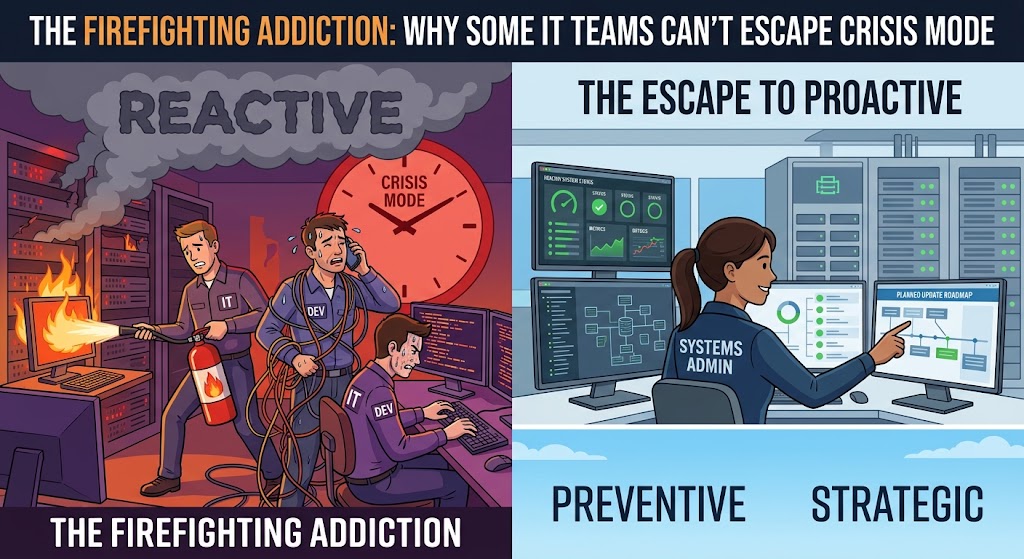

The hero trap is what happens when a team or an organisation rewards the person who rescues the situation more than the person who made sure there was no situation to rescue. It looks like a good thing. The server goes down at 2 am, one engineer fixes it in twenty minutes and everyone applauds. But the same fault caused the same outage last month, and nobody asked why it happened twice. In this pattern, speed of repair becomes the measure of success, while the quiet work of prevention stays invisible, unfunded and unrewarded.
In this guide we explain how the hero trap works, why it quietly costs Australian businesses time, money and good people, and how to replace firefighting with prevention using proven approaches such as ITIL 4 problem management, incident management and continual improvement. If you lead an IT team, run a service desk, manage operations or simply keep getting pulled into the same emergencies, this is for you.
What Is the Hero Trap?
The hero trap is a pattern where heroic effort is praised, repeated and slowly built into the culture, even though it is a sign that something upstream is broken. The hero is usually capable, committed and generous with their time. That is exactly why the pattern is so hard to see. Everyone is grateful, nobody is being careless and the immediate problem really does get solved.
The trouble is what this pattern teaches. It tells people that visible rescue is the path to recognition, and that careful, boring prevention is a lower-status activity. Over time, teams optimise for dramatic recoveries, because that is what gets noticed, and the underlying causes stay exactly where they are.
Why Fixing Problems Fast Feels Like Success
Fast fixes are satisfying for good reasons. They are concrete, measurable and emotionally rewarding. Metrics such as time to resolve, tickets closed and response speed are easy to report, and a quick save is a story everyone can retell. Prevention, by contrast, produces a non-event. When a problem never happens, there is no incident report, no thank-you email and no story. You cannot photograph a disaster that did not occur.
This asymmetry is the engine of the problem. What gets measured gets managed, what gets rewarded gets repeated and what is invisible gets cut when budgets tighten. Teams that only celebrate resolution end up living in permanent reaction mode.
The Real Cost of the Hero Trap
Repeat Incidents Eat Your Capacity
Every recurring incident is a tax. The same fix is paid for again and again in engineer hours, customer frustration and lost focus. A team stuck in this pattern often spends so much time on repeat problems that it never has room to remove the causes.
Your Best People Burn Out
Heroes carry the pager, the knowledge and the stress. When the same few people are always the rescuers, they become single points of failure and eventually leave, often taking critical knowledge with them.
Risk Hides Behind Success
Because the hero keeps saving the day, leaders believe the system is healthy. Fragile processes, poor documentation and unmanaged change are never exposed, until the day the hero is on leave and the problem is bigger than any one person.
Customers Lose Trust Quietly
Customers do not remember how impressively you recovered. They remember that it broke. Reliable services build trust, while repeated recoveries, however fast, erode it.
7 Signs Your Team Is Caught in the Hero Trap
- The same incidents keep returning under slightly different names.
- One or two people are always the ones who “just know” how to fix things.
- Praise goes to late-night rescues, while preventive improvements go unmentioned.
- Root cause analysis is skipped once service is restored.
- Your backlog of known errors keeps growing and nobody owns it.
- Changes are rushed into production with little testing or risk assessment.
- Planned improvement work is the first thing cancelled when things get busy.
If three or more of these sound familiar, your team is probably inside the hero trap.
Why Preventing Problems Completely Is More Valuable
Prevention wins because its value compounds. A fast fix saves one incident. A permanent fix removes every future occurrence of that incident. Done well, one afternoon of root cause analysis can save hundreds of hours over a year.
Prevention also improves the things leaders actually care about: availability, customer satisfaction, security and predictability. Research programs such as DORA have long studied how stable delivery and fast recovery go together in high-performing technology teams, and Google’s guidance on postmortem culture explains why learning from failure without blame is central to reliability. The message is consistent: the best teams do not just recover quickly, they learn so they do not need to recover as often.
It is also a security issue. The Australian Cyber Security Centre publishes practical guidance at cyber.gov.au that repeatedly stresses basic hygiene, patching and preparation over emergency response. Escaping this pattern makes you safer as well as calmer.
How to Escape the Hero Trap: A Practical Framework

1. Separate Restoring Service From Fixing the Cause
Incident management exists to restore service quickly. Problem management exists to find and remove the underlying cause. This pattern collapses these into one job and stops after the first. Make them distinct, with different owners, goals and measures.
2. Make Root Cause Analysis Routine
After every significant or repeated incident, ask why it happened, why it was not detected earlier and what would stop it recurring. Use blameless reviews so people share honestly rather than hide mistakes.
3. Track and Own Known Errors
Keep a visible register of known errors with owners, workarounds and target dates. Treat it like a product backlog, not a graveyard.
4. Reward Prevention Out Loud
Change what you celebrate. Recognise the engineer who retired a recurring fault, improved monitoring or simplified a fragile process. If prevention earns the same praise as rescue, behaviour follows.
5. Measure Repeat Incidents, Not Just Resolution Speed
Add measures such as repeat incident rate, number of problems closed and change failure rate. What you measure signals what you value.
6. Strengthen Change Enablement
Many incidents start with changes. Clear risk assessment, testing and approval proportionate to the risk reduces the supply of emergencies at the source.
7. Protect Time for Improvement
Reserve a fixed share of capacity for improvement work and defend it. Without protected time, the hero trap always wins, because urgent beats important.
How ITIL 4 Helps You Escape the Hero Trap
ITIL 4 is a widely used framework for IT service management, and many of its practices speak directly to this problem: incident management, problem management, change enablement, service desk, monitoring and event management, and continual improvement. Together they give teams a shared language and a structured way to move from reacting to preventing.
If you or your team want structured training, these are good places to begin:
- ITIL 4 Foundation Certification: build a common understanding of service management concepts, practices and terminology.
- ITIL 4 Managing Professional: go deeper into practical service management, delivery and improvement.
- ITIL 4 Strategic Leader: align digital and IT strategy with business direction.
You can compare every pathway on the ITIL certifications page, or read the frequently asked questions to see which level suits your role.
Hero Trap Examples Across Australian Cities
This pattern shows up wherever IT and operations teams are stretched. Training is available in major cities, with live online and classroom options depending on location.
Sydney: Large finance, retail and technology teams often run on tight release cycles that reward rapid rescues. See ITIL training in Sydney.
Melbourne: Government, health and enterprise IT teams benefit from consistent problem and change practices. Explore ITIL training in Melbourne.
Brisbane: Growing technology, resources and public sector teams need scalable service processes. Visit ITIL training in Brisbane.
Perth: Resources and engineering operations depend on reliable systems. Check ITIL training in Perth.
Adelaide and Canberra: Government and defence services demand dependable, well-governed IT. Learn more about Adelaide and Canberra training, or browse all locations.
A 30-60-90 Day Plan to Get Out of the Hero Trap
- First 30 days: list your top ten repeat incidents, find the owners and agree on a simple problem record process.
- Days 31 to 60: run root cause reviews on the top three, fix the causes and publish the results to the team.
- Days 61 to 90: introduce repeat incident and change failure measures, protect improvement time and recognise the first prevention wins publicly.
Within a quarter, you can show leaders fewer repeat incidents and calmer on-call weeks, which is the most persuasive proof that leaving it behind pays off.
Frequently Asked Questions About the Hero Trap
What is the hero trap in IT and business?
It is a culture that rewards dramatic problem fixing over problem prevention, which keeps recurring issues alive and burns out the people who rescue the situation.
Is fixing problems fast ever the right priority?
Yes. Restoring service quickly matters during an incident. The hero trap appears when speed is the only thing celebrated and the cause is never removed.
How does ITIL problem management prevent repeat incidents?
It identifies the underlying causes of incidents, records known errors with workarounds and drives permanent fixes, so the same issue stops returning.
Which ITIL certification should I start with?
Most people begin with ITIL 4 Foundation to learn the core concepts, then move to Managing Professional or Strategic Leader depending on their role and goals.
Conclusion: Make Prevention the Real Heroics
Fast fixes will always have a place, but they are the cost of imperfection, not the mark of excellence. The hero trap persuades good teams to celebrate the cost and ignore the cure. Real heroism is the unglamorous work of finding causes, removing risk and building services that rarely break.
Ready to move from firefighting to prevention? Explore the full range of ITIL certifications, learn more about us, read practical guides on the blog, or contact us for advice on the right course. You can also call 1300 649 299.