




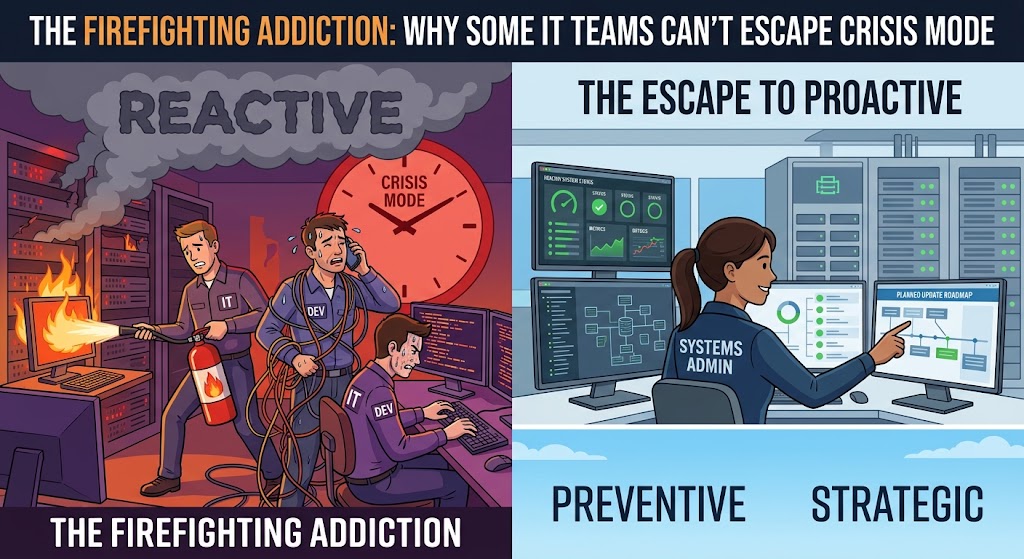
IT stability is quietly becoming the thing customers notice most, and most boards still treat it as a cost centre. Think about the last time a payment page froze, a booking app logged you out, or a hospital portal refused to load. You didn’t blame “a server”. You blamed the company. That is why a calm, predictable IT environment has stopped being a back-office virtue and turned into a genuine competitive edge for Australian businesses.
The idea is simple. Organisations that fix problems once, change systems safely and keep services running while everyone else is firefighting end up with happier customers, steadier teams and fewer expensive surprises. This guide explains what IT stability really means, what it costs when it’s missing, how to measure it, and how ITIL 4 training helps teams build it, with practical steps for Sydney, Melbourne, Brisbane, Perth, Adelaide and Canberra.
What Is IT Stability and Why Does It Matter Now?
IT stability means your technology does what people expect, when they expect it, week after week. It isn’t the same as “never having an incident”. Every system fails eventually. A stable IT environment is one where failures are rare, short, understood and rarely repeated.
Three shifts have pushed IT stability up the agenda. First, almost every customer interaction now runs through software, so an outage is a brand moment, not a technical footnote. Second, hybrid work and cloud platforms have multiplied the number of moving parts, which makes careless change far riskier. Third, regulators and enterprise buyers increasingly ask about resilience before they sign contracts. If your answer is “we usually recover quickly”, you’re competing against rivals who can say “this rarely happens”.
The Hidden Cost of Constant Firefighting
Reactive IT feels busy and productive. Tickets close, heroes emerge, someone gets thanked on Slack at 11pm. But a team that lives in firefighting mode is paying a hidden tax every single week.
- Repeat incidents. The same fault returns because nobody had time for root-cause analysis, so the same people lose the same evening again.
- Change anxiety. Releases get delayed or rushed because the last one went badly. Both choices slow the business down.
- Burnout and churn. Experienced engineers leave stressed teams first, and their knowledge walks out with them.
- Lost trust. Sales, finance and operations quietly build workarounds, which creates shadow IT and more risk.
None of this shows up neatly in a budget line, which is exactly why it persists. The benefit of IT stability, in contrast, compounds. Every problem you permanently remove frees capacity for the next improvement.
How Calm IT Becomes a Competitive Edge
Calm doesn’t mean slow or sleepy. It means the organisation can move quickly because it trusts its own platform. Here’s how the two operating styles compare day to day.
| Area | Reactive IT | Calm, stable IT |
| Incidents | Fixed fast, then forgotten | Fixed fast, then investigated through problem management |
| Changes | Risky, often after hours | Risk-assessed, small and reversible through change enablement |
| Knowledge | Lives in people’s heads | Documented, searchable and kept current |
| Customer view | “They’re always down” | “They’re dependable” |
| Team mood | Heroics and fatigue | Predictable workload and room to improve |
| Business impact | Lost sales and rework | Faster launches and stronger renewals |
Customers rarely thank you for IT stability, because good service is invisible. They simply stay. In sectors such as finance, healthcare, education, retail and government, that quiet loyalty is worth far more than another feature announcement.
Five Habits That Create IT Stability
Stable IT isn’t magic and it isn’t expensive tooling. It comes from a handful of repeatable habits, most of which map directly to practices in the ITIL 4 framework from PeopleCert. You can read the official ITIL guidance from PeopleCert for the full framework.

1. Treat incident management as a speed skill
Incident management is about restoring service fast. Clear priorities, defined escalation paths and good communication keep a small fault from becoming a headline. Our guide to incident management vs problem management explains where one ends and the other begins.
2. Invest in problem management
This is the habit that separates calm teams from busy ones. Problem management asks “why did this happen, and how do we make sure it can’t happen again?” Even one root-cause review a fortnight changes the shape of your ticket queue within a quarter.
3. Make change enablement boring
Boring is the goal. Small changes, peer review, rollback plans and honest risk ratings let teams ship often without drama. If your organisation is also working through people-side transitions, our partners at change management courses cover the human side of change.
4. Watch your services, not just your servers
Monitoring and event management should tell you something is wrong before customers do. Alert on what people experience (login times, checkout success) rather than only CPU graphs. Google’s site reliability engineering book is a useful, free read on service-level thinking.
5. Build continual improvement into the week
Continual improvement shouldn’t be a project that starts next quarter. Put a small, standing slot in the calendar, fix one irritant, and share the result. The ITIL 4 practices explained article walks through all ten core practices if you want a roadmap.
Where Security and IT Stability Meet
Security and stability are closer cousins than most teams admit. Unpatched systems fail more often and are breached more easily. Messy access and undocumented changes cause outages and audit findings. The Australian Cyber Security Centre’s Essential Eight guidance is a sensible baseline, and disciplined patching, backups and change control improve both resilience and uptime. Mature IT service management gives those controls a home.
How to Measure IT Stability
You can’t improve what you can’t see, and “it feels better lately” won’t survive a budget meeting. Track a small set of indicators and review them monthly. Start with these.
| Measure | What it tells you |
| Mean time to restore (MTTR) | How quickly services come back after an incident |
| Repeat incident rate | Whether root causes are really being removed |
| Change failure rate | How safe your releases and updates are |
| Service availability | What customers actually experience, by service |
| SLA and XLA results | Whether you meet targets and whether users feel served; see SLA vs XLA |
| Customer and staff satisfaction | Whether the calm is real or just quiet |
Pick a baseline today, even if the numbers look ugly. Improvement is far more convincing when people can see a trend line moving the right way.
A Practical 90-Day Plan for Calmer IT
- Days 1 to 30: see clearly. List your top ten recurring incidents, map your most critical services and agree how you’ll measure IT stability.
- Days 31 to 60: remove the repeats. Run root-cause reviews on the top three offenders, tidy your knowledge base and introduce a lightweight change approval routine.
- Days 61 to 90: lock in the habits. Publish a simple service dashboard, hold a monthly improvement review and train the people who own incident, problem and change work.
That last step matters. Processes only stick when people share the same language and understand why the rules exist, which is where certification earns its keep.
Why ITIL 4 Training Builds IT Stability
Frameworks don’t fix systems; trained people do. ITIL 4 gives service desks, operations teams and managers a shared vocabulary for incidents, problems, changes and improvement, so everyone pulls in the same direction. Here’s where to start.
- New to service management? Begin with ITIL 4 Foundation certification to learn the Service Value System and core practices.
- Leading day-to-day delivery? The ITIL 4 Managing Professional designation goes deeper into create, deliver and support, drive stakeholder value and high-velocity IT.
- Setting strategy? The ITIL 4 Strategic Leader pathway suits senior leaders who align digital strategy with business outcomes.
Wondering about investment and return? Our ITIL certification cost guide and ITIL salary guide break down fees and career outcomes. You can also browse the full ITIL course range at Logitrain or see the ITIL 4 Foundation course page.
IT Stability Training Across Australian Cities
Stable IT looks a little different in every market. Canberra leans on government assurance, Sydney and Melbourne on finance and large-scale digital services, Brisbane and Perth on resources and infrastructure, and Adelaide on defence, health and growing tech. Wherever you are, you can train in person or live online.
| City | Typical IT stability focus | ITIL training page |
| Sydney | Finance, SaaS, always-on customer platforms | ITIL training Sydney |
| Melbourne | Enterprise IT, healthcare, education, digital agencies | ITIL training Melbourne |
| Brisbane | Infrastructure, utilities, government services | ITIL training Brisbane |
| Perth | Resources, remote operations, 24/7 support | ITIL training Perth |
| Adelaide | Defence, health, growing tech sector | ITIL training Adelaide |
| Canberra | Government assurance and secure service delivery | ITIL training Canberra |
Prefer a city-based classroom? Logitrain also lists local options for IT courses in Sydney, Melbourne, Brisbane, Perth, Adelaide and Canberra. Teams that want training at their own site can ask about in-house delivery on the contact page.
Frequently Asked Questions About IT Stability
What does IT stability mean in simple terms?
It means your systems and services work reliably, failures are uncommon and short, and the same problem doesn’t keep coming back. It’s about predictable service rather than perfect technology.
How is IT stability different from IT security?
Security protects systems from threats, while stability keeps them dependable for users. They overlap heavily, since patching, access control and change management support both goals.
Can small businesses improve IT stability without a big budget?
Yes. Start with a clear incident process, a shared knowledge base, regular patching and one root-cause review each month. Habits matter more than tools, and many are free.
Which ITIL 4 practices help most with IT stability?
Incident management, problem management, change enablement, monitoring and event management, knowledge management and continual improvement make the biggest difference. Our ITIL 4 Foundation course introduces all of them.
Is ITIL certification worth it for service desk staff?
For most people, yes. It builds a common language, supports career moves into incident, change and service management roles, and shows employers you understand how stable services are run. See our ITIL career path guide for typical progression.
Do you offer ITIL courses online as well as in cities?
Yes. Sessions run live online for learners anywhere in Australia, and in major cities including Sydney, Melbourne, Brisbane, Perth, Adelaide and Canberra. Check the locations page or the FAQs.
Make Calm Your Competitive Advantage
The organisations that win over the next few years won’t necessarily be the ones shipping the flashiest features. They’ll be the ones customers can count on. IT stability is built through small, boring, repeatable habits: fix the cause, change safely, learn from every incident and train your people properly.
Ready to build that capability? Explore our ITIL certifications, pick the pathway that fits your role, or speak with the team on 1300 649 299 about live online, city-based or in-house training.