



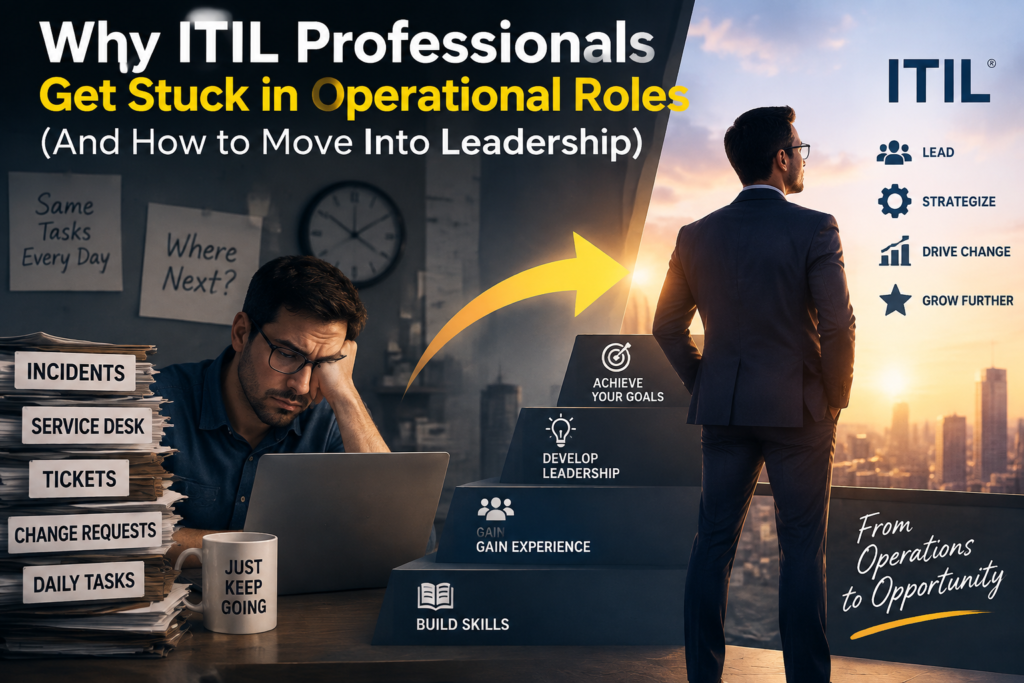

ITIL certifications don’t lead to promotions automatically, and that catches a lot of IT professionals off guard. You study the Service Value System, sit the exam, add the badge to your resume, and wait for the next role to open up. Then the promotion goes to someone else, someone with less formal training but a clearer track record of visible, measurable impact.
This isn’t a knock on ITIL. It’s one of the most widely adopted IT service management frameworks in the world for good reason, and it genuinely does correlate with higher pay and stronger job prospects. But ITIL certifications don’t lead to promotions in isolation, because certification and promotion are measured by two different things: what you know versus what you’ve demonstrably done with it.
Why ITIL Certifications Don’t Lead to Promotions on Their Own
Career advancement research is consistent on this point: promotions go to professionals who combine technical skill with strategic visibility and documented accomplishments, not credentials alone. Here’s exactly where ITIL certification stops short.
1. Foundation-Level Certification Signals Awareness, Not Leadership
ITIL 4 Foundation proves you understand core ITSM concepts, incident management, problem management, change enablement, the Service Value System. It’s a strong starting point, but it’s an awareness-level credential. Most promotion decisions, especially into management or strategic roles, look for evidence of applied leadership, which Foundation alone doesn’t demonstrate.
2. No Measurable Business Impact Attached to the Certification
A certification on its own doesn’t show a reduction in incident resolution time, an improvement in service level compliance, or a cost saving delivered through better change management. Without a measurable result attached, ITIL certifications don’t lead to promotions because there’s nothing concrete for a manager to point to when making the case.
3. Certification Without Strategic Visibility Goes Unnoticed
Promotions rarely happen in a vacuum. If leadership doesn’t know you hold the certification, or more importantly, doesn’t know what you’ve done with it, it has little influence on the decision. Visibility, communicating outcomes clearly and consistently, matters as much as the credential itself.
4. Promotions Are Tied to Documented Accomplishments, Not Credentials Alone
Most organisations map certifications to eligibility for a role, not automatic advancement into it. A help desk analyst with a relevant certification becomes eligible for a more senior role; they still need a documented track record to actually win it.
5. Stopping at Foundation When the Target Role Needs More
Roles in service delivery leadership, IT operations management or strategic planning typically expect ITIL 4 Managing Professional or Strategic Leader level capability, not Foundation alone. Staying at the entry tier while targeting a senior role is one of the most common, and most fixable, reasons for a stalled promotion case.
What Employers Really Reward Instead
Once you understand why ITIL certifications don’t lead to promotions by themselves, the path forward becomes much clearer. Employers consistently reward five things beyond the certificate.
Demonstrated Process Improvements
A specific example, reducing recurring incidents through better problem management, or shortening change approval cycles, does more for a promotion case than the certification that taught you the theory behind it.
Cross-Team Collaboration and Communication
ITIL’s own guiding principles emphasise collaboration and visibility. Professionals who can clearly explain service impact to both technical teams and business stakeholders consistently stand out in promotion conversations.
Ownership of Incidents, Problems and Change
Taking visible responsibility for an outcome, not just following the process, is what managers remember when a role opens up. It’s the difference between knowing the framework and being trusted to run it.
Business-Aligned Thinking
Employers pay more for professionals who can connect service management directly to value, cost and customer experience, not just process compliance. This is exactly what the higher ITIL 4 levels are designed to build.
The Right Certification Tier for the Role You Want
ITIL 4 Managing Professional signals hands-on, technical ITSM leadership capability, while ITIL 4 Strategic Leader is built for those steering IT strategy at a senior level. Matching your certification tier to your actual target role removes one of the most common blockers to promotion.
How to Turn ITIL Certification into Real Career Progression
Structured, instructor-led training builds both the certification and the applied capability employers actually promote for. ITIL Certification Training offers accredited courses across every stage of the ITIL 4 pathway.

Certification pathways to build genuine, promotion-ready ITSM capability include:
- ITIL 4 Foundation Certification — core ITSM concepts and the Service Value System
- ITIL 4 Managing Professional Designation — hands-on, technical ITSM leadership capability
- ITIL 4 Strategic Leader — strategic, senior-level IT leadership
Each pathway is instructor-led and built around real-world scenarios, so the certification is backed by the applied, demonstrable capability employers actually reward with promotion.
ITIL Certification Training Available in Cities Across Australia
Training is available in person or live online, so wherever you’re based, you can start building a stronger promotion case: Melbourne, Sydney, Brisbane, Perth, Adelaide, and Canberra.
Frequently Asked Questions
Why don’t ITIL certifications lead to promotions automatically?
ITIL certifications don’t lead to promotions automatically because most organisations use certification to determine eligibility for a role, not automatic advancement into it. Promotions still require documented accomplishments and visible impact.
Which ITIL level should I get to advance into management?
ITIL 4 Managing Professional is generally the right level for hands-on ITSM leadership roles, while ITIL 4 Strategic Leader suits professionals targeting senior, strategy-focused IT leadership positions.
What should I do alongside ITIL certification to get promoted?
Document specific process improvements, communicate outcomes clearly to leadership, and take visible ownership of incidents and change initiatives. Structured training through ITIL Certification Training builds the applied skills that back this up.
Is ITIL certification still worth it if it doesn’t guarantee promotion?
Yes. ITIL remains one of the most widely recognised ITSM frameworks globally and correlates with stronger job prospects and higher pay. It’s a genuine asset, just not a substitute for demonstrated, documented impact.
Ready to turn ITIL certification into a real promotion case? Contact the ITIL Certification team and get matched with the right training pathway.