





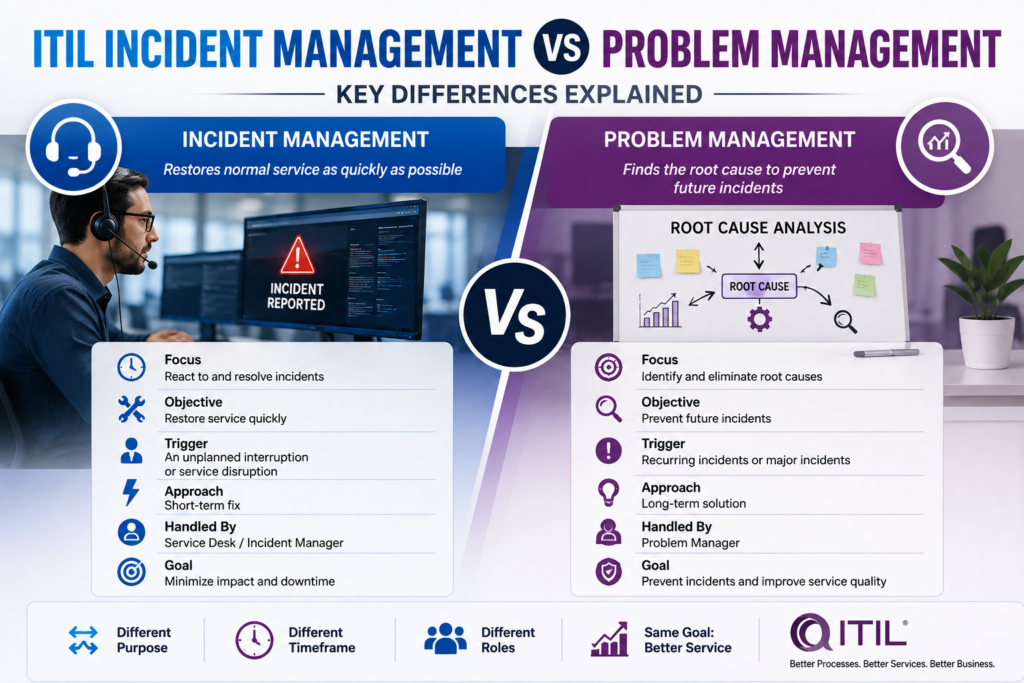
ITIL Incident Management vs Problem Management is one of the most commonly confused pairs of concepts for anyone new to IT service management in Australia. Both practices sit inside the ITIL 4 framework and both deal with things going wrong — but they solve different problems, run on different timelines, and are usually owned by different people within an IT team in Sydney, Melbourne, Brisbane, Perth, Adelaide or Canberra.
In simple terms: Incident Management is about restoring service as fast as possible. Problem Management is about finding and removing the underlying cause so the incident doesn’t happen again. This guide breaks down ITIL Incident Management vs Problem Management in detail, with practical examples and career guidance for Australian IT professionals.
What Is ITIL Incident Management?
Incident Management is the ITIL 4 practice focused on restoring normal service operation as quickly as possible after an unplanned interruption or reduction in quality, minimising the impact on business operations. Speed, not root cause, is the priority.
- Goal: restore service as quickly as possible, using workarounds if needed.
- Timeframe: minutes to hours — driven by service level agreements (SLAs).
- Typical actions: log the incident, categorise and prioritise it, apply a known fix or workaround, restore service, close the ticket.
- Success measure: time to resolution and SLA compliance.
What Is ITIL Problem Management?
Problem Management is the ITIL 4 practice focused on identifying and managing the causes of incidents, reducing the likelihood and impact of incidents by identifying actual and potential causes, and managing workarounds and known errors.
- Goal: find and eliminate the root cause behind one or more incidents.
- Timeframe: days to weeks driven by investigation depth, not urgency.
- Typical actions: root cause analysis, documenting known errors, raising change requests, tracking permanent fixes.
- Success measure: reduction in repeat incidents and improved service stability over time.
ITIL Incident Management vs Problem Management: Side-by-Side Comparison
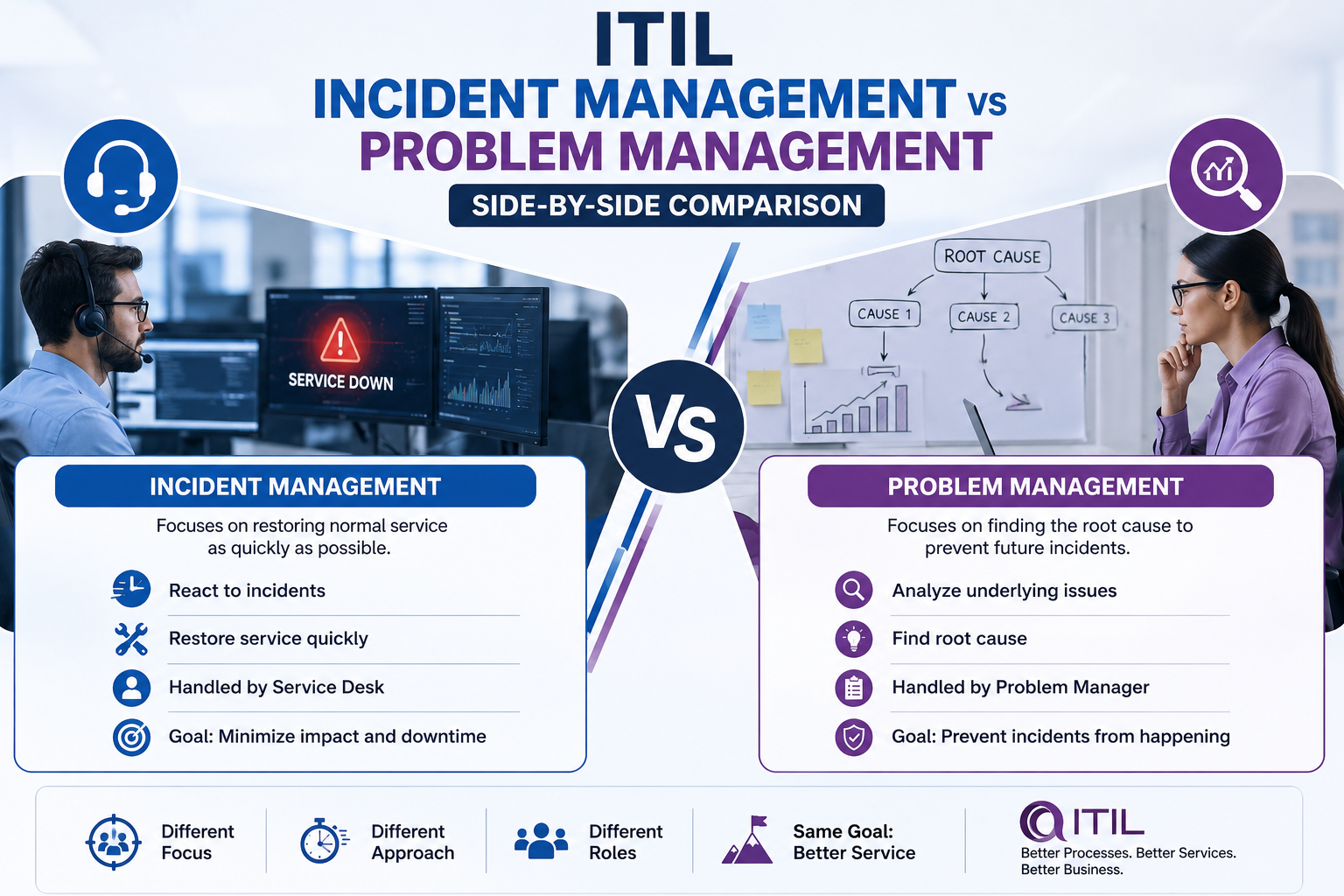
| Aspect | Incident Management | Problem Management |
| Primary goal | Restore service quickly | Prevent recurrence by fixing root cause |
| Focus | Symptoms and impact | Underlying cause |
| Speed vs depth | Fast, often reactive | Slower, investigative and analytical |
| Common output | Workaround or temporary fix | Known error record, permanent fix, change request |
| Typical owner | Incident Manager / Service Desk | Problem Manager |
| Relationship to changes | May trigger an emergency change | Often triggers a planned change to fix root cause |
| Success metric | Mean time to resolve (MTTR), SLA compliance | Reduction in incident volume and recurrence rate |
ITIL Incident Management vs Problem Management in Practice
A simple, real-world example makes the ITIL Incident Management vs Problem Management distinction clear:
A payroll system goes down on a Friday afternoon in a Melbourne finance company. The service desk logs an incident, restarts the affected service, and payroll processing resumes within 40 minutes — that’s Incident Management doing its job. Two weeks later, the same payroll system fails again, and a third time the following month. At this point, Problem Management takes over: investigating server logs, identifying a memory leak in a recent software update as the root cause, and raising a change request to patch it permanently closing the underlying problem, not just the symptom.
This is also why ITIL 4 explicitly links the two practices through the concept of a known error a problem that has been analysed but not yet permanently fixed, with a documented workaround in place for the service desk to use if the same incident recurs.
Why the Distinction Matters for Australian IT Teams
- Treating every recurring incident as a one-off wastes service desk time and frustrates end users.
- Skipping proper root cause analysis leads to the same outages repeating, damaging service reliability metrics reported to leadership.
- Clear separation of roles avoids the service desk being pulled into long investigations while live incidents pile up.
- Employers specifically test candidates on this distinction in ITIL-related interviews, since confusing the two is a common and easily spotted gap in real-world understanding.
Roles: Incident Manager vs Problem Manager
In most Australian IT service management teams, these are related but distinct roles:
- Incident Manager — coordinates the response to active incidents, manages communication with stakeholders, and ensures SLA targets are met during an outage.
- Problem Manager — leads root cause investigations, maintains the known error database, and works with change management to implement permanent fixes.
- In smaller Australian organisations, one person often holds both responsibilities; in larger enterprises and government agencies, they are typically separate, dedicated roles.
How ITIL 4 Certification Builds This Knowledge
Both Incident Management and Problem Management are core practices covered in the ITIL 4 Foundation certification, which gives IT professionals a shared vocabulary and structured understanding of how these practices connect across the service value chain.
For professionals who want to specialise further, the ITIL 4 Managing Professional stream goes deeper into practices like Incident Management and Problem Management, preparing candidates for service delivery and operations leadership roles.
If you’re weighing up whether ITIL certification is worth the investment for your career, our ITIL Salary Guide Australia breaks down salary ranges by role and certification level, and our ITIL Certification Cost Australia guide covers exam fees and training costs in detail.
These courses are part of the wider training portfolio at Logitrain, an Australian IT training provider with a track record of preparing candidates for real workplace and interview scenarios.
ITIL Incident Management vs Problem Management: Demand Across Australian Cities
- Sydney — large financial-services and corporate IT teams typically run dedicated Incident and Problem Manager roles.
- Melbourne — retail, logistics and healthcare IT teams often combine both responsibilities in mid-sized service desk teams.
- Brisbane — government and utilities favour ITIL-certified staff who understand both practices for audit and compliance reporting.
- Perth — mining and resources IT teams prioritise fast incident resolution given the cost of operational downtime.
- Adelaide — defence and manufacturing sectors increasingly formalise problem management to reduce recurring system outages.
- Canberra — government agencies frequently require ITIL 4 Foundation as a baseline for IT service management roles.
Further Resources
These official resources are useful for deeper reference on ITIL practices:
PeopleCert — official ITIL certification body
Axelos — ITIL 4 glossary of terms
SEEK Australia — current ITIL and IT service management job listings
Frequently Asked Questions
What is the main difference between ITIL Incident Management and Problem Management?
Incident Management restores service as quickly as possible, while Problem Management investigates and removes the root cause so the same incident doesn’t happen again.
Can one person handle both Incident Management and Problem Management?
Yes, particularly in smaller Australian organisations. Larger enterprises and government agencies more often separate the roles because the skills and time commitment required differ significantly.
Do I need separate ITIL certifications for incident and problem management?
Both are covered within ITIL 4 Foundation and explored in greater depth in the ITIL 4 Managing Professional stream, so a single certification path covers both practices.
Ready to Build ITIL Service Management Skills?
Understand ITIL Incident Management vs Problem Management and the full ITIL 4 practice set with itilcertification.com.au flexible training for IT professionals across Sydney, Melbourne, Brisbane, Perth, Adelaide and Canberra. Explore the full course catalogue at Logitrain.