



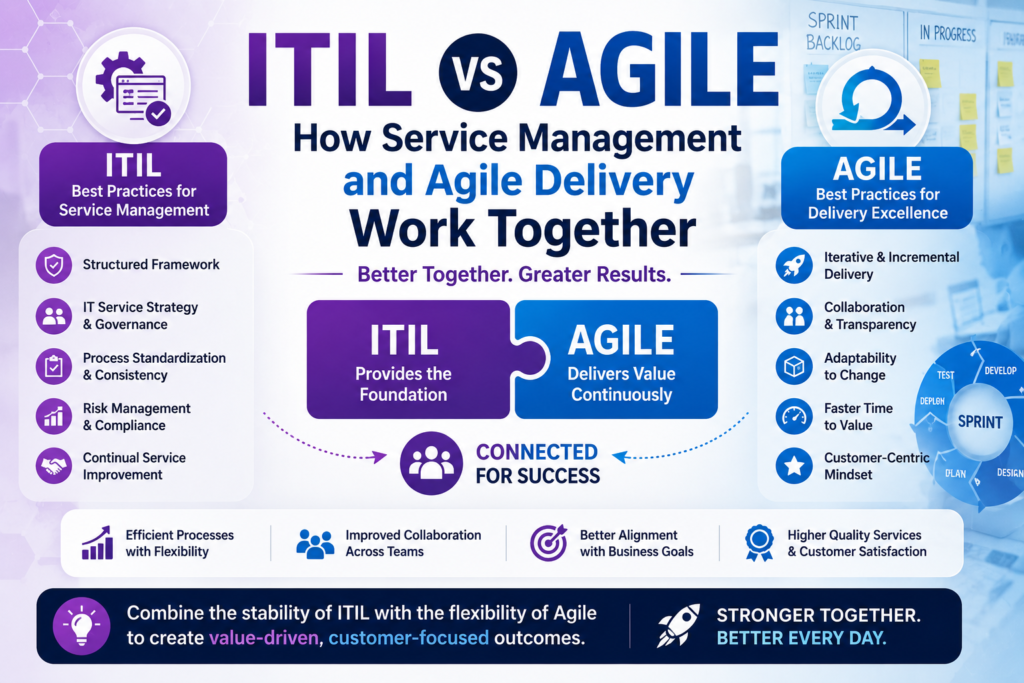
A lot of IT professionals treat ITIL vs Agile as an either/or decision, as if choosing one framework rules out the other. In practice, the two aren’t competitors they solve different problems, and most mature IT organisations across Australia run them side by side. This guide explains what each framework actually does, where they overlap, and how teams in Sydney, Melbourne, Brisbane, Perth, Adelaide and Canberra are combining both to ship faster without losing control of their services.
What Is ITIL?
ITIL (Information Technology Infrastructure Library) is a framework for managing IT services across their entire lifecycle from request and change management through to incident resolution and continual improvement. It gives organisations a common language and a repeatable process for keeping services stable, secure and aligned with business goals. ITIL 4, the current version, shifted away from rigid process silos toward a more flexible, value-driven approach, which is part of why the ITIL vs Agile conversation has become so relevant.
What Is Agile?
Agile is a delivery methodology built around short iterative cycles, frequent feedback and adapting plans as requirements change. Rather than locking in a fixed scope up front, Agile teams work in sprints, review progress constantly, and adjust direction based on what they learn. It’s the dominant approach in modern software development, and increasingly shows up in IT operations and service teams too. If you’re new to the ITIL side of this pairing, our ITIL 4 Foundation training page covers the entry-level certification most professionals start with.
ITIL vs Agile: Side-by-Side Comparison
| Factor | ITIL (Service Management) | Agile (Delivery) |
|---|---|---|
| Primary focus | Managing and improving IT services end-to-end | Delivering working software in short, iterative cycles |
| Origin | IT service management (ITSM) framework | Software development methodology |
| Typical audience | Service desk, IT operations, change/incident managers | Developers, Scrum Masters, product teams |
| Cadence | Ongoing service lifecycle, planned change windows | Sprints, usually 1–4 weeks |
| Core certification | ITIL 4 Foundation, Managing Professional, Strategic Leader | Scrum Master, Product Owner, SAFe certifications |
| How they combine | Provides governance, risk control and service continuity | Provides speed, flexibility and continuous delivery |
Where ITIL vs Agile Actually Clash
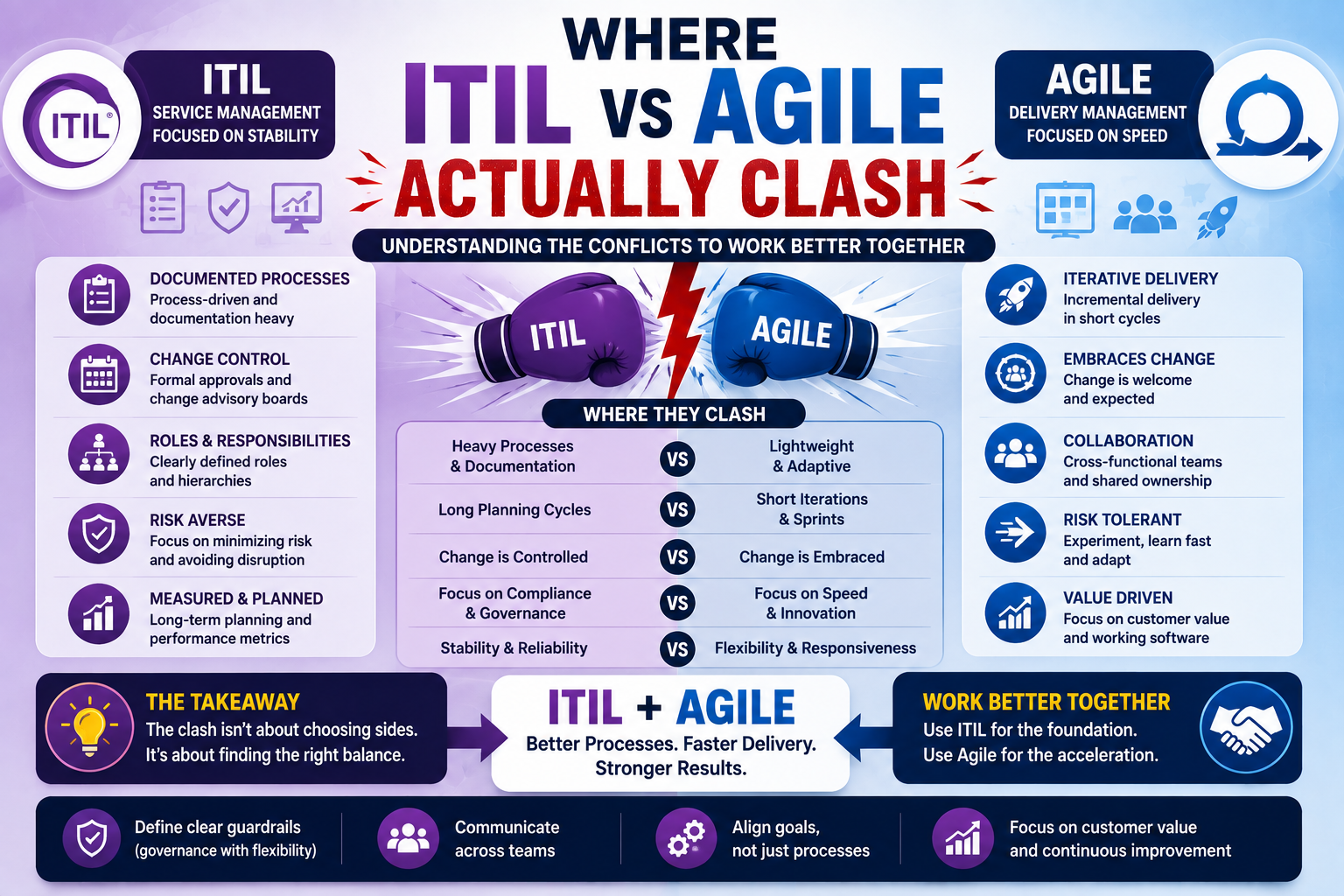
The friction usually isn’t philosophical it’s operational. Agile teams want to ship changes fast; traditional ITIL change management can involve approval boards and lead times that feel slow by comparison. Left unmanaged, that mismatch causes real tension: developers see ITIL as red tape, and service managers see Agile as a risk to stability. The good news is that ITIL 4 was specifically redesigned to close this gap.
How ITIL and Agile Work Together in Practice
- Lightweight, tiered change approval — low-risk changes get fast-tracked, high-risk changes still go through full review.
- Service teams embed with Agile squads instead of sitting in a separate silo, shortening feedback loops.
- ITIL’s continual improvement practice pairs naturally with Agile retrospectives — both exist to make the next cycle better than the last.
- Incident and problem management data feeds directly into sprint planning, so recurring issues get prioritised as backlog items.
Which Certification Should You Start With?
If your role sits closer to service desk, operations or change management, ITIL 4 Foundation is the natural starting point it’s the credential employers screen for most often in Australian ITSM job ads. From there, many professionals progress into the ITIL Managing Professional stream to build deeper practice-level expertise. If you’re coming from a development or product background, a Scrum or Agile certification is usually the better first move, with ITIL added later once you’re working closely with service teams.
Career Demand and Salary Expectations in Australia
ITIL-certified professionals stay in consistent demand across Sydney, Melbourne, Brisbane, Perth, Adelaide and Canberra, particularly in government, finance and large enterprise IT teams that need structured service management alongside faster Agile delivery. For a full breakdown of what ITIL-certified professionals earn city by city, see our ITIL certification salary in Australia guide.
Where to Train in ITIL
Logitrain runs instructor-led ITIL 4 courses across Australia’s major cities, as well as live online delivery for regional students. You can see current course dates and delivery formats through Logitrain’s instructor-led ITIL courses. Whether your team is Agile-first, ITIL-first, or already blending both, a structured ITIL 4 Foundation course gives you the shared vocabulary needed to work across both frameworks.
Official ITIL Resource
For the official ITIL 4 framework details and certification scheme, Axelos (the framework owner) maintains up-to-date guidance at axelos.com/certifications/itil-service-management, which is worth bookmarking alongside any structured course.
Final Thoughts
The ITIL vs Agile debate misses the point once you see how the two frameworks actually get used in the field: ITIL keeps services stable, secure and improving over time, while Agile keeps delivery fast and responsive to change. Organisations that combine both, rather than picking a side, end up with teams that can ship quickly without losing control of the services those changes affect and that combination is exactly what employers across Australia are hiring for.