


Reactive IT looks busy all the time, and that is exactly the problem. The service desk queue never empties, the on-call phone keeps ringing and the team finishes every week exhausted. From the outside it looks like hard work. From the inside it often feels like running on a treadmill: plenty of effort, and the same place on the map.
Many Australian IT teams live in this pattern without having chosen it. Each urgent issue is a reasonable thing to fix. But when urgent work consumes every available hour, nothing gets prevented, nothing gets improved and tomorrow brings the same fires with slightly different names.
This guide explains why reactive IT stays busy but rarely gets ahead, what it quietly costs the business and how ITIL certification training gives teams a practical way to shift from firefighting to prevention.
What Is the Firefighting Economy in IT?
The firefighting economy is a self-reinforcing cycle inside an IT team. Incidents create demand. Heroic effort supplies the fix. Praise and recognition reward the rescue. And because the rescue gets rewarded, nobody invests in the unglamorous work that would stop the next incident from happening.
Think of it as a small economy with its own currency, which is urgency. Whatever is loudest gets the attention, regardless of whether it matters most. Reactive IT is simply the daily life inside that economy.
Why Reactive IT Always Looks Busy
Reactive IT is visibly busy for several reasons, and most of them are built into how teams are measured:
- Queues never clear. Every resolved ticket is replaced by another, so the workload looks endless.
- Metrics reward activity. Tickets closed and response times are easy to count, so they become the scoreboard, even though they say little about whether services are getting better.
- Heroes are visible. The engineer who fixes an outage at midnight gets noticed. The engineer who quietly prevents ten outages doesn’t.
- Attention is fragmented. Chat pings, calls and escalations break the day into small pieces, so even good people feel permanently behind.
Busyness is easy to mistake for value. Here, being busy is the default state, not evidence of progress.
Why Reactive IT Rarely Gets Ahead
The deeper issue is compounding. Every problem left unfixed behaves like a debt that charges interest, and reactive IT pays that interest every day without ever reducing the balance.
- The same incidents keep returning. Without root cause work, a fix only treats the symptom. The issue reappears next week or next month.
- Unplanned work crowds out planned work. Improvement projects, patching and documentation get pushed aside by whatever is on fire today.
- Knowledge stays in people’s heads. When fixes aren’t written down, the same issue is solved from scratch each time, usually by the same few people.
- Risk quietly builds. Skipped maintenance and rushed changes create the next outage. Some fires are lit by the previous firefight.
- People wear out. Constant interruption leads to burnout, and when experienced staff leave, the cycle restarts with less skill in the room.
That is the central trap. The more time spent firefighting, the less time exists to prevent fires, so the fires keep coming.
Signs Your Team Is Stuck in Reactive IT
You can usually spot the pattern without a formal assessment:
- The top ten ticket types look almost the same every month.
- A handful of people are called on for every serious problem.
- Planned projects regularly slip because of “urgent” work.
- Nobody can say what percentage of the week is planned versus unplanned.
- Changes are rushed, and a noticeable share of incidents follow a recent change.
- Success is described as “we got through the week” rather than “we reduced incidents”.
- Prevention work, such as problem records or knowledge articles, is always “next quarter”.
If four or more of these sound familiar, your team is probably running a reactive IT model. The good news is that it is a habit and a system, not a personal failing.
The Hidden Costs of Reactive IT
These costs rarely appear as a single line in the budget, which is why they persist. They show up in places that are harder to trace:
- Slower projects. Strategic initiatives lose people and attention to daily emergencies.
- Lower business trust. Users learn to expect disruption and stop believing IT can be proactive.
- Higher turnover. Skilled staff burn out, and recruiting and training replacements is expensive.
- Greater risk. Skipped maintenance and rushed changes raise the likelihood of serious outages.
- Weaker decisions. Leaders can’t plan investment when the team has no time to produce reliable data about its own services.
These costs affect every sector that depends on technology, including government, healthcare, finance, education and telecommunications.
Reactive IT vs Proactive IT
| Area | Reactive IT | Proactive IT |
| Primary focus | Fix whatever is on fire today | Remove the causes of tomorrow’s fires |
| Success measure | Tickets closed, response times | Recurring incidents reduced, service stability improved |
| Recurring incidents | Accepted as normal | Tracked, analysed and eliminated |
| Team morale | Exhausted, dependent on heroes | Calmer, with shared knowledge |
| Business view | IT is a cost and a source of disruption | IT is a reliable partner in delivering value |
| Planning | Calendar dictated by emergencies | Planned improvement time protected |
Proactive doesn’t mean ignoring incidents. Incidents still happen, and fast recovery still matters. The difference is that a proactive team also asks why each incident happened and removes the cause.
How ITIL 4 Helps Teams Break Out of Reactive IT
ITIL 4 is a globally recognised framework for IT service management (ITSM). Its practices give teams a shared structure for moving from reaction to prevention. If you want the bigger picture first, see how ITIL 4 supports digital transformation and value co-creation.
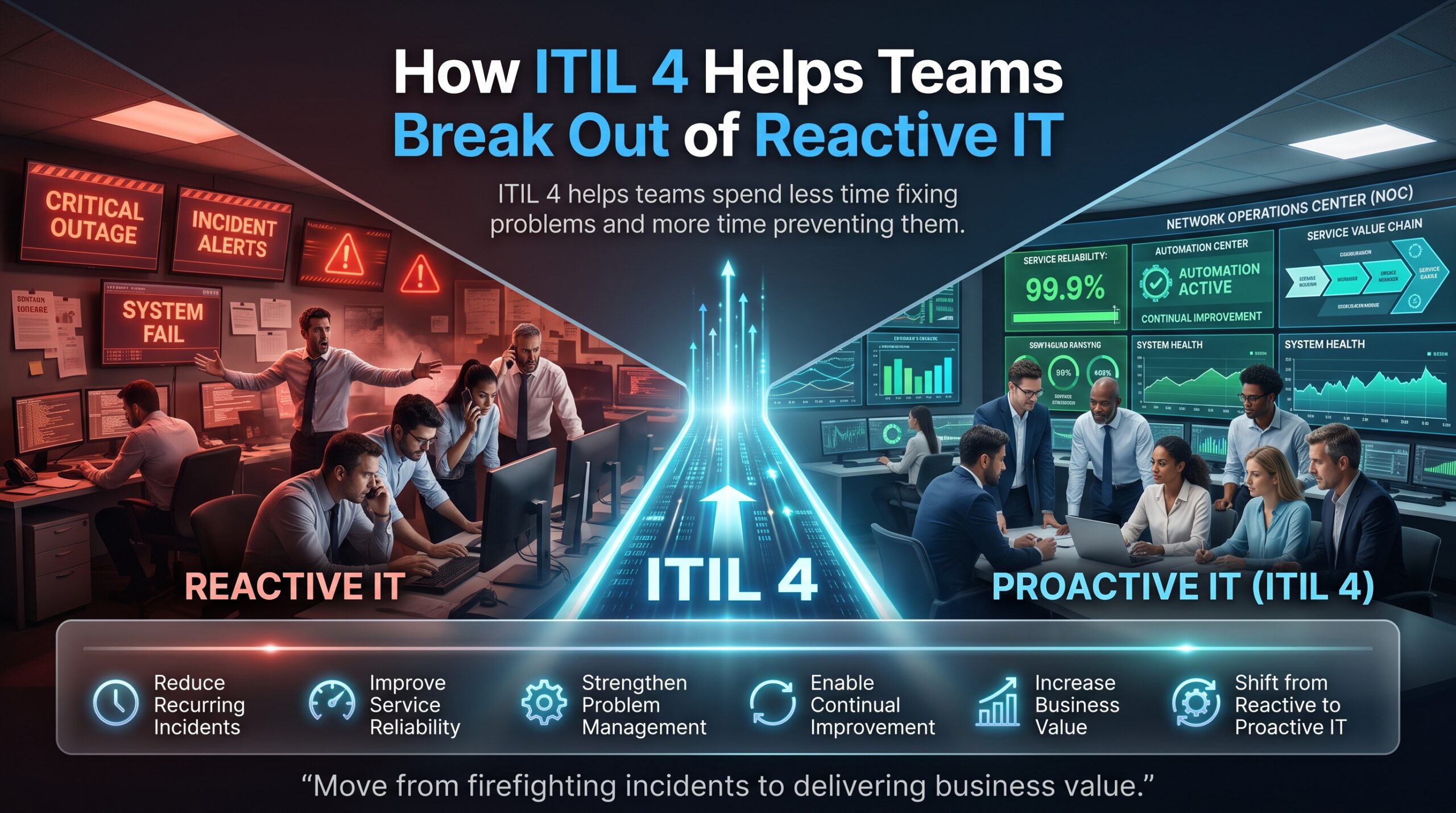
The table below shows how common ITIL 4 practices reduce firefighting:
| ITIL 4 Practice | How It Reduces Firefighting | Where to Learn |
| Incident management | Restores service quickly and consistently, with clear priorities | ITIL 4 Foundation |
| Problem management | Finds and removes root causes so incidents stop recurring | ITIL 4 Foundation |
| Change enablement | Reduces self-inflicted incidents from rushed or risky changes | ITIL 4 Managing Professional |
| Monitoring and event management | Detects issues early, before users feel them | ITIL 4 Managing Professional |
| Knowledge management | Stops the same fix being rediscovered again and again | ITIL 4 Foundation |
| Continual improvement | Makes prevention routine rather than occasional | ITIL 4 Strategic Leader |
Our ITIL 4 Foundation certification is a good starting point for the shared language, while the ITIL 4 Managing Professional designation builds depth in the practices behind stable, reliable services. Leaders can go further with ITIL 4 Strategic Leader.
A Practical Plan to Get Ahead of Reactive IT
You don’t need a large transformation to start. This six-step plan works for most teams:
- Measure the split. For four weeks, record how much time goes to planned versus unplanned work. The number is usually uncomfortable and always useful.
- Rank your repeat offenders. List the ten incident types that recur most often and the time each one consumes.
- Protect improvement time. Rotate one person as the dedicated “firefighter” each week so the rest of the team can work on prevention without constant interruption.
- Open problem records. Take the top three repeaters through root cause analysis and track each fix to completion.
- Write down what you know. Create a short knowledge article for each recurring ticket type so fixes stop being rediscovered.
- Change the scoreboard. Add measures such as recurring incident rate and incidents prevented, and report them alongside tickets closed.
Review the numbers monthly. Even small reductions in repeat incidents free up hours that can be reinvested into the next improvement.
Reactive IT in Action: Six Examples From Australian Workplaces
These are composite examples based on common patterns, not individual case studies:
- Financial services in Sydney: the same password reset and access requests consume a large part of the service desk. Self-service and knowledge articles would remove much of that load, but nobody has time to build them.
- Healthcare in Melbourne: recurring printer and login issues pull technicians away from system upgrades, so the upgrades slip every quarter.
- Local government in Brisbane: rushed changes before a deadline cause outages, and the outages cause more rushed fixes. Better change enablement would break the loop.
- Resources in Perth: a small team supports remote sites and spends most of its time responding to connectivity alerts. Improved monitoring and event management would catch problems earlier.
- Manufacturing in Adelaide: one senior engineer holds the knowledge for key systems. When that person is away, every problem becomes a crisis.
- Government in Canberra: a long list of incidents is closed within target, yet the same causes reappear. A formal problem management process would reduce them.
Where Reactive IT Costs the Most Across Australia
It affects every region, but it hurts most where services are critical and teams are small. This is a broad picture rather than a forecast:
- Sydney: finance and professional services teams where downtime is expensive. See ITIL training in Sydney.
- Melbourne: healthcare, education and retail organisations with always-on services. See ITIL training in Melbourne.
- Brisbane: infrastructure, local government and growing service businesses. See ITIL training in Brisbane.
- Perth: resources and energy operators with remote sites and lean IT teams. See ITIL training in Perth.
- Adelaide: health, manufacturing and defence-related organisations. See ITIL training in Adelaide.
- Canberra: government agencies where service reliability is closely scrutinised. See ITIL training in Canberra.
Training is offered in major cities and through live online delivery, with in-house options for teams. See all ITIL training locations in Australia.
For IT Leaders: Change What Gets Rewarded
It persists because it is rewarded. If heroics earn the praise and prevention earns silence, people will keep choosing heroics. Start by recognising the engineer who removed a recurring problem as clearly as the one who fixed an outage. Ask for recurrence data in reviews. Give the team protected time for improvement, and treat it as part of the job rather than a bonus.
Structured frameworks help make this consistent. ITIL is now managed by PeopleCert, whose official resources explain the framework and its qualifications. Pair that with team-wide training so everyone shares the same language for incidents, problems and improvement.
Frequently Asked Questions
What is reactive IT?
Reactive IT is a way of working where the team responds to problems after they occur rather than preventing them. It is characterised by constant urgent work, recurring incidents and little time for planned improvement.
Why do IT teams stay in firefighting mode?
Usually because the system rewards it. Heroic fixes are visible and praised, metrics count activity rather than prevention, and urgent work leaves no time to address root causes.
How does ITIL help reduce firefighting?
ITIL 4 provides practices such as problem management, change enablement, monitoring and event management, knowledge management and continual improvement. Together they help teams find root causes, reduce self-inflicted incidents and make improvement routine.
What is the difference between incident management and problem management?
Incident management restores service as quickly as possible. Problem management investigates the underlying cause so the incident doesn’t keep happening. Reactive IT does plenty of the first and very little of the second.
Which ITIL course should I start with?
Most professionals start with the ITIL 4 Foundation certification. No formal prerequisites are required, and it gives you the shared vocabulary to start changing how your team works.
Are ITIL courses available in Sydney, Melbourne, Brisbane, Perth, Adelaide and Canberra?
Yes. Training is available in major Australian cities and through live online delivery. See the FAQ page or contact our team for details.
Final Thoughts: Stop Fighting Fires and Start Preventing Them
Reactive IT will always look busy, because it is busy. The real question is whether that busyness is building anything. Teams that measure recurring problems, protect time for prevention and use a proven framework steadily convert firefighting hours into improvement hours.
Ready to build practical service management skills? Explore our ITIL certification courses, or call 1300 649 299 and speak to a course advisor about the right pathway for you.