



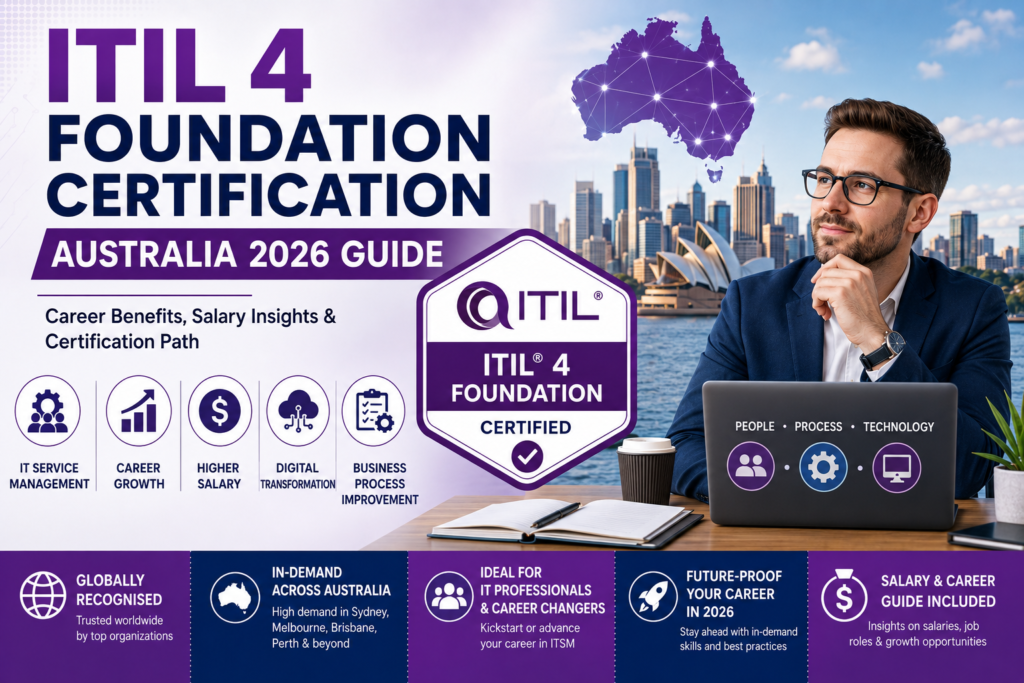
If you’re weighing up an ITIL 4 Foundation certification Australia against the time and cost involved, you’re asking a fair question before you commit. ITIL is the world’s most widely adopted IT service management framework, and ITIL 4 Foundation is the entry point almost every ITSM professional passes through. This guide breaks down what the certification actually costs, how it affects salary and job prospects across Australian cities, who genuinely benefits from it, and whether it’s worth the investment in 2026.
What Is ITIL 4 Foundation Certification?
ITIL 4 Foundation is the introductory certification in the ITIL qualification scheme, owned and administered by PeopleCert. It covers the Service Value System (SVS), the guiding principles of ITIL, the service value chain, and a high-level overview of key ITIL practices such as Incident Management, Problem Management, Change Enablement, Service Level Management and Continual Improvement. It’s not a technical certification there’s no coding or platform-specific configuration involved it’s a shared vocabulary and framework for how IT services should be planned, delivered and improved.
ITIL 4 Foundation Certification Cost in Australia
Pricing varies by training provider and whether you choose classroom, live online or self-paced eLearning, and exam voucher pricing is set by PeopleCert and reviewed periodically. Rather than quoting a fixed dollar figure that may be outdated by the time you read this, check current pricing directly with your training provider and PeopleCert’s official pricing page. As a general pattern, bundled course-plus-exam packages typically cost less than purchasing training and an exam voucher separately, so it’s worth comparing both options before enrolling.
Is ITIL 4 Foundation Certification Worth It in Australia in 2026?

For most people working in or around IT service delivery, yes. ITIL 4 Foundation won’t single-handedly land you a senior role, but it does two things well: it gives you a shared vocabulary that makes cross-team collaboration easier, and it signals to employers that you understand how modern IT services should be planned, delivered and improved. It’s particularly worth it if your job already touches incident management, change management, service desk operations, or IT project coordination areas where ICT Managers and related occupations are tracked as steady, in-demand roles across Australia. It’s a weaker case if your role is purely technical development work with no service management exposure in that scenario, a different certification may serve your career better.
ITIL Certified Salary in Australia
Salary impact depends heavily on the role you’re applying ITIL knowledge to, not the certification alone. ITIL 4 Foundation is rarely the sole factor in a pay rise, but it frequently appears as a listed requirement or preferred qualification in service desk, incident management and IT operations job ads, which affects who gets shortlisted in the first place.
Typical Roles That Value ITIL 4 Foundation
- IT Service Desk Analyst entry to mid-level, ITIL terminology used daily
- Incident Manager / Problem Manager mid-level, ITIL practices are the job
- Change Manager mid to senior, change enablement is core ITIL territory
- Service Delivery Manager / ICT Operations Manager senior, often requires ITIL plus people leadership experience
- ITSM Consultant senior, usually built on ITIL 4 Foundation plus Managing Professional or Strategic Leader modules
ITIL Careers by Australian City
ITSM roles are advertised across every major Australian city. Melbourne and Sydney have the deepest concentration of service desk and service delivery roles across finance, telco and enterprise IT. Brisbane and Perth see steady demand from government and resources-sector IT teams. Adelaide and Canberra have consistent opportunities tied to defence, health and public-sector service management roles, where ITIL is often a stated requirement rather than a nice-to-have.
Career Path After ITIL 4 Foundation
ITIL 4 Foundation is a starting point, not a destination. Once you’re comfortable with the core concepts, the ITIL qualification scheme branches into two main streams: the ITIL 4 Managing Professional designation, aimed at IT practitioners who manage services day to day, and the ITIL 4 Strategic Leader stream, aimed at professionals influencing IT strategy at a leadership level. Most people spend a year or more applying Foundation-level knowledge on the job before deciding which stream fits their career direction.
Who Should Get ITIL 4 Foundation Certified?
- IT support and service desk staff who want structured career progression
- System administrators and IT operations staff working towards a management track
- Project managers and business analysts working inside ITIL-adopting organisations
- Career changers moving into IT service management from another industry
- Anyone whose employer has adopted ITIL practices and needs staff speaking the same language
There are no formal prerequisites for ITIL 4 Foundation, which is exactly why it’s such a common entry point beginners and experienced IT professionals sit the same exam and benefit from it differently, depending on what they already do day to day.
The Move to ITIL Version 5
PeopleCert is progressively introducing ITIL Foundation (Version 5), with a bridge module for existing ITIL 4 holders who want to upgrade by focusing only on what’s changed. If you’re deciding when to sit your exam, this isn’t a reason to wait ITIL 4 Foundation remains valid, widely recognised, and the version most Australian job ads reference right now. Employers are expected to catch up to Version 5 gradually rather than all at once, so certifying now and bridging later, if needed, is a perfectly reasonable strategy.
How to Get ITIL 4 Foundation Certified in Australia
The ITIL 4 Foundation Certification course is delivered instructor-led, combining the Service Value System, guiding principles and key ITIL practices with exam-focused preparation. Training runs across six major Australian city locations as well as live online, so you can study alongside full-time work without relocating or taking extended leave.
Steps to Get ITIL 4 Foundation Certified
- Choose your preferred format — in-class in a major city, or live online from anywhere in Australia.
- Enrol in a structured ITIL 4 Foundation course that includes exam-focused practice questions.
- Work through the Service Value System, guiding principles and core ITIL practices systematically.
- Sit practice exams until you’re consistently scoring above the pass mark.
- Book and complete your official ITIL 4 Foundation exam through your training provider.
Not sure which track or location suits you? Contact the ITIL Certification team to talk through course dates, delivery options and pricing, or check the FAQs page for quick answers to common questions.
Frequently Asked Questions
Is ITIL 4 Foundation certification worth it for beginners in Australia?
Yes, particularly if you’re working in or entering IT support, service desk or IT operations roles. There are no prerequisites, and it gives beginners a structured framework that’s widely recognised by Australian employers.
How much does ITIL 4 Foundation certification cost in Australia?
Cost varies by provider, delivery format and whether the exam voucher is bundled with training. Check current pricing directly with your training provider, since PeopleCert reviews exam pricing periodically.
Does ITIL 4 Foundation guarantee a salary increase?
Not by itself. It’s more accurate to say ITIL 4 Foundation improves your shortlisting chances for ITSM-related roles and gives you the vocabulary to perform better in service management positions, both of which can support salary growth over time.
Should I wait for ITIL Version 5 instead of getting ITIL 4 now?
No ITIL 4 Foundation remains valid and widely used, and a bridge module will let you upgrade to Version 5 later if you choose to. Waiting means delaying a certification that’s already useful today.
What comes after ITIL 4 Foundation?
Most professionals move into either the ITIL 4 Managing Professional stream (practical service management) or the ITIL 4 Strategic Leader stream (IT strategy and leadership), depending on their career direction.